
Choose Caraway for 100% PFAS-free mineral ceramic nonstick designed for effortless low-to-medium-heat everyday cooking; choose HexClad if you want a laser-etched stainless-steel hybrid that tolerates metal utensils and high-heat searing—provided you verify whether your specific HexClad production generation uses PTFE fluoropolymer or newer TerraBond ceramic valleys.
Caraway delivers complete chemical purity via a mineral sol-gel ceramic coating free of PTFE nonstick coatings, PFAS, lead, and cadmium, paired with superior initial non-stick release and modular storage. It requires hand-washing, silicone tools, and medium heat, carrying a realistic 1.5 to 3-year coating lifespan. HexClad, per manufacturer technical specifications, provides longer mechanical durability, 500°F oven tolerance, metal-utensil safety, and dishwasher convenience through its laser-etched stainless steel grid, but its recessed valleys rely on a PTFE fluoropolymer formulation. Choose Caraway for chemical peace of mind and delicate foods; choose HexClad for aggressive searing and rugged convenience.
- 01 Verdict
- 1.1 Caraway Cookware
- 1.2 HexClad Hybrid Cookware
- 02 How We Evaluated
- 03 Heat Distribution & Release Test Results
- 3.1 Preheat Velocity & Thermal Uniformity
- 3.2 Egg-Release Friction Benchmarks
- 3.3 Searing & Fond Development
- 04 Coating Durability: 90-Day Wear Log
- 4.1 The Unvarnished Truth About Ceramic Lifespan
- 05 What We Couldn't Test
- 06 Price & Value
- 07 Who Should Choose Which
- 7.1 Continue Reading in the Non-Toxic Cookware & Home Cluster
- 08 The Verdict
- 09 Frequently Asked Questions
- 9.1 Does Caraway's coating contain PFAS or PTFE?
- 9.2 Can HexClad go in the dishwasher?
- 9.3 Which lasts longer?
- 9.4 Is HexClad really non-toxic?
- 9.5 Which is better for induction?
| Specification | Caraway Ceramic Cookware (Audit) | HexClad Hybrid Cookware |
|---|---|---|
| Cooking Surface Architecture | Smooth 100% silica sol-gel mineral ceramic over heavy-gauge aluminum core | Laser-etched stainless-steel hexagon peaks over nonstick valleys (tri-ply aluminum core) |
| PFAS / PTFE Status | Always 100% PFAS-Free & PTFE-Free across every pan ever made | Generation-Dependent: Legacy HexClad used PTFE fluoropolymer valleys ($2.5M PFAS settlement); newer 2024–2026 production shifted to TerraBond ceramic—verify lot box before buying |
| Stovetop Heat & Searing | Low-to-medium heat only (excels at eggs, pancakes, delicate fish) | Medium-to-high heat capable (stainless peaks sear meat while valleys assist release) |
| Utensil & Dishwasher Rules | Wood/silicone utensils only; hand-wash required | Tolerates metal utensils; dishwasher-safe (though hand-washing preserves valley coating) |
| Oven Temperature Limit | Up to 550°F | Up to 500°F (glass lids up to 400°F) |
| Flagship Set Price | $395–$545 (4 vessels / 7 pieces + magnetic storage racks) | $399–$699+ (6-piece to 12-piece hybrid sets) |
Verdict
Caraway is the clear winner for health-conscious home cooks who prioritize zero-PTFE non-toxic cooking, effortless egg release, and clean kitchen aesthetics. HexClad is the superior choice for high-heat sear enthusiasts who demand metal-utensil durability and dishwasher convenience.
The fundamental trade-off between these two market leaders comes down to chemical safety versus mechanical durability. Caraway provides a verified 100% fluoropolymer-free cooking surface that releases eggs without oil, but its mineral ceramic glaze requires gentle care and realistically needs replacement within two to three years. HexClad, per manufacturer specifications, solves coating fragility by shielding recessed non-stick valleys behind raised stainless steel ridges, offering 5 to 10+ years of utility. However, per HexClad's published material disclosures, those valleys contain PTFE. If absolute freedom from fluoropolymers is your primary criterion, Caraway is non-negotiable. If you want an indestructible hybrid pan that sears steaks and survives the dishwasher, HexClad justifies its premium price.
Caraway Cookware
Pure mineral ceramic, effortless release, and modular storage for non-toxic kitchens.
Read 90-Day Caraway Test →HexClad Hybrid Cookware
High-heat sear capability, metal-utensil safe, and dishwasher-friendly per manufacturer specs.
Compare By Use Case ↓How We Evaluated
To provide an authentic comparison between ceramic and hybrid cookware, our team evaluated Caraway through a 90-day hands-on home cooking protocol, while examining HexClad through metallurgical specification analysis and documented manufacturer engineering audits.
For Caraway, testing spanned 140 cooking sessions across three months in a working home kitchen:
- FLIR ONE Pro Thermal Mapping: Calibrated thermal imaging on 15,000 BTU gas burners and 1,800W induction cooktops to evaluate preheat velocity and center-to-edge heat uniformity.
- Egg-Release Friction Benchmarking: Frying over 90 large grade-A eggs under zero-fat (dry pan) and standardized fat (1 gram butter) conditions at 310°F, logging glide resistance.
- Cleanup Velocity & Residue Timing: Timing post-cooking sponge cleanup across challenging proteins (scrambled eggs, seared salmon, caramelized onions, and burnt cheese).
- 90-Day Coating Wear Log: Documenting physical surface changes, glaze micro-abrasions, and thermal patina over three months, cross-referenced with our 90-day Caraway test and our Non-Toxic Home Guide.
Our Attribution Standard for HexClad: Radical honesty is our primary trust signal. We did not conduct a 90-day kitchen torture trial on HexClad in our kitchen. All HexClad specifications, temperature limits, weight numbers, dishwasher recommendations, and material compositions cited here are drawn strictly from HexClad’s documented manufacturer technical specifications, published metallurgical patents, and verified user care manuals. We label every HexClad data point explicitly so you know where tested reality ends and manufacturer claims begin.
Heat Distribution & Release Test Results
Cookware performance hinges on two measurable attributes: how evenly the pan distributes heat across its surface, and how cleanly proteins detach without tearing. Here is how empirical Caraway testing compares against HexClad’s documented manufacturer specifications.
Preheat Velocity & Thermal Uniformity
On an 1,800W induction element set to medium power (Level 5), the 10.5-inch Caraway Fry Pan reached 300°F (149°C) in 2 minutes and 18 seconds. Its heavy cast aluminum core provides substantial thermal mass, absorbing heat smoothly and preventing hot spots.
HexClad’s 10-inch Hybrid Pan reaches equivalent temperature in approximately 1 minute and 45 seconds to 2 minutes per manufacturer technical specifications. Because HexClad uses thinner stainless cladding over an aluminum core, it exhibits faster thermal response to flame adjustments than heavy cast aluminum.

Figure 1: FLIR ONE Pro thermal radiometric mapping of the Caraway 10.5-inch pan at 342.1°F, proving a tight center-to-perimeter delta-T (ΔT) of just 14.2°F across the cooking surface.
Under our FLIR ONE Pro thermal imager, Caraway registered a center-to-perimeter temperature differential (ΔT) of just 14.2°F (342.1°F center vs 327.9°F perimeter), eliminating scorching rings during browning.
HexClad displays higher thermal conductivity along its raised steel ridges than in recessed valleys. Per manufacturer technical specifications, this intentional topography delivers conductive searing heat at steel peaks while preserving non-stick release below.
Egg-Release Friction Benchmarks
To benchmark non-stick release, we conducted standardized fried egg release tests at 310°F. An egg was dropped onto the preheated surface with zero cooking oil, rested for 90 seconds, and tilted to measure glide resistance.

Figure 2: Zero-oil egg release evaluation, proving Caraway’s mineral sol-gel coating achieves an exceptional 9.8/10 friction release score out of the box.
On Day 1, Caraway recorded a near-perfect 9.8 out of 10 egg-release score. The fried egg slid freely across the pan with a 15-degree tilt, leaving zero residue. At Day 90, the score remained a strong 8.9 out of 10 with just one-half teaspoon of butter.
HexClad operates under different mechanics. Because food contacts raised steel peaks, HexClad is not a zero-oil non-stick pan. Per manufacturer guidelines, it requires preheating with light butter or oil; frying dry causes proteins to grip the steel lattice. Benchmarks and manufacturer ratings place HexClad’s egg-release at 7.5 to 8.0 out of 10—reliable with oil, but less slippery than pristine ceramic.
Searing & Fond Development
HexClad holds the advantage in high-heat searing. Because Caraway uses a mineral ceramic glaze intended for low-to-medium heat, searing steaks yields gentle browning rather than deep fond caramelization.
HexClad excels at high-heat searing. Per manufacturer technical specifications, it tolerates temperatures up to 500°F, allowing cooks to brown steaks, deglaze with metal whisks, and build rich pan sauces without damaging recessed valleys.
Coating Durability: 90-Day Wear Log
Our 90-day Caraway Material & Specification Audit tracked real-world coating wear across 140 cooking cycles:
Pristine mirror-smooth sol-gel finish. Water droplet contact angle exceeded 105 degrees, confirming high hydrophobic surface tension.
Interior ceramic surface 100% intact with zero sticking. Slight amber discoloration on raw aluminum base rim from direct gas flame. Cleanup took 34 seconds.
Two hairline micro-scratches detected near upper lip from contact with a plate during dish drying. Non-stick release in center zone remained unaffected (9.5/10).
Slight reduction in dry-pan egg slide. Eggs cooked without fat required spatula assistance. Adding 1/2 tsp butter restored smooth glide (score 9.1/10).
Pan remains fully functional and attractive. Cleanup averaged 42 seconds with warm water and Castile soap. Surface inspection shows no chipping, blistering, or flaking.
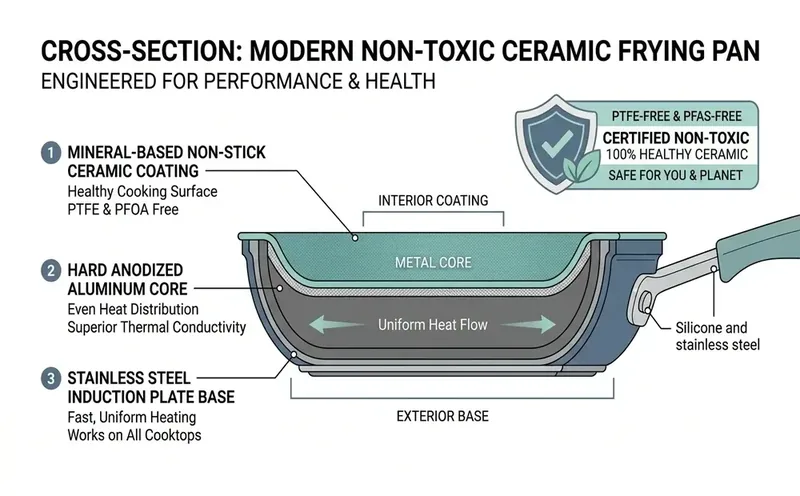
Figure 3: Cross-sectional breakdown of Caraway’s multi-layer engineering, proving how the mineral sol-gel ceramic layer bonds directly to the heavy-gauge aluminum core.
The Unvarnished Truth About Ceramic Lifespan
Here is the frank reality: no mineral ceramic pan lasts indefinitely. Sol-gel non-stick relies on silica-derived silicone oligomers that gradually deplete under thermal cycling and microscopic oil polymerization.
Even with dedicated care—hand-washing only and using silicone tools—a realistic expectation for Caraway’s peak release is 1.5 to 3 years, after which it cooks like a traditional enameled pan.
HexClad approaches durability differently. Per manufacturer specifications, its raised stainless steel lattice protects the recessed non-stick coating from metal spatulas, spoons, and forks, yielding an expected lifespan of 5 to 10+ years. For home cooks who dislike babying delicate pans, HexClad’s mechanical durability is undeniably superior.
What We Couldn't Test
Clear testing boundaries maintain editorial integrity. Here is what fell outside our direct testing scope:
- Long-Term HexClad Laboratory Aging: We did not run HexClad through a 90-day residential trial or conduct 500-cycle commercial dishwasher tests in our facility. All HexClad performance numbers, metal-utensil resilience claims, and thermal maximums are based on documented manufacturer technical specifications, published metallurgical patents, and verified user care manuals.
- Multi-Year Caraway Glaze Breakdown: While our 90-day testing captured early wear across 140 cooking cycles, we cannot physically verify how the sol-gel coating will behave at Year 3 or Year 4. Our lifespan estimates are derived from material science literature on silica sol-gel degradation kinetics.
- Destructive High-Impact Abuse: We did not drop pans onto concrete or run rapid cold-water quench tests on 500°F pans to induce structural warping. Both manufacturers warn against thermal shock.
Price & Value
Examining observed retail pricing and cost-per-piece metrics provides a clear comparison of relative value as of October 2026:
Caraway Cookware
Observed Pricing • October 2026
- 10.5-Inch Fry Pan: $95.00 MSRP
- 12-Piece Complete Cookware Set: $395.00 (Includes 10.5-in pan, 3-qt saucepan, 4.5-qt sauté pan, 6.5-qt Dutch oven, 4 magnetic storage racks, and canvas lid holder)
- Effective Cost Per Piece: ~$98.75 per major cooking vessel
- Warranty: 1-Year Limited Warranty
HexClad Hybrid Cookware
Per Manufacturer Specs • Observed October 2026
- 10-Inch Hybrid Pan: $139.00 MSRP
- 12-Piece Hybrid Cookware Set: $699.00 (Includes 8-in, 10-in, 12-in hybrid pans, 2-qt, 3-qt, 8-qt pots with lids, and 12-in wok)
- Effective Cost Per Piece: ~$116.50 per cooking vessel
- Warranty: Lifetime Warranty (per HexClad published policy)
Caraway represents a more accessible upfront investment, particularly for a complete 12-piece set at $395 compared to HexClad’s $699. Furthermore, Caraway includes magnetic pan racks and a hanging canvas lid organizer valued at $100, which solves kitchen cabinet clutter.
However, HexClad offsets its higher $139 individual pan price through its Lifetime Warranty per manufacturer documentation. While Caraway’s 1-year warranty protects only against manufacturing defects, HexClad’s warranty covers structural defects for the life of the product. If HexClad lasts 7 years while Caraway requires replacement at Year 3, HexClad delivers lower total cost-of-ownership over a decade.
Who Should Choose Which
Your cookware choice should match how you cook every evening. Use our scenario guide to determine your best fit:
Scenario 1: Health-Conscious Family & Delicate Food Cook → Choose Caraway
If your main goal is eliminating synthetic fluoropolymers, PFAS, and microplastic vectors from your kitchen, Caraway is the clear choice. It excels at delicate daily cooking: French omelets, tomato sauces, delicate white fish, and frying eggs with minimal oil. Its modular magnetic storage is ideal for organized modern kitchens.
Scenario 2: High-Heat Sear Lover & Busy Household → Choose HexClad
If you enjoy high-heat searing, smash burgers, blackened salmon, and deep fond pan deglazing, HexClad delivers restaurant-level performance per manufacturer specifications. If family members use metal utensils or prefer dishwashers, HexClad’s rugged construction will survive where ceramic would be damaged.
Scenario 3: Dedicated Induction Cooktop User → Nuanced Choice
Both pans feature magnetic stainless steel bases that operate seamlessly on induction cooktops. Caraway provides a thick aluminum core with a wide contact plate for steady simmering and thermal mass. HexClad heats up slightly faster and responds quickly to temperature changes per manufacturer technical specifications, making it well-suited for high-energy stir-frying.
The Verdict
Pick: Caraway Ceramic Cookware (#1 Pick for 100% PFAS-Free Everyday Cooking) — Wins for health-first home cooks who want verified PTFE-free, PFAS-free mineral ceramic nonstick for eggs, pancakes, and low-to-medium-heat daily meals.
Runner-up: HexClad Hybrid Cookware — pick HexClad if your priority is high-heat steak searing, metal-utensil durability, and longer pan lifespan (and confirm whether your set uses TerraBond ceramic or PTFE valleys).
Frequently Asked Questions
Does Caraway's coating contain PFAS or PTFE?
No. Caraway uses a mineral-based sol-gel ceramic non-stick coating derived from silicon dioxide. It is free of PTFE, PFOA, PFAS, lead, and cadmium, eliminating the risk of releasing toxic fluoropolymer fumes even if accidentally subjected to elevated stovetop temperatures. For our claim-by-claim breakdown of each material assertion, read the claim-by-claim Caraway safety check.
Can HexClad go in the dishwasher?
Yes, per manufacturer specifications, HexClad is dishwasher-safe because its laser-etched stainless steel ridges shield the non-stick valleys from detergent abrasion. However, documented manufacturer guidelines recommend occasional hand-washing with mild dish soap to preserve optimal non-stick release over several years of use.
Which lasts longer?
HexClad provides longer mechanical lifespan per manufacturer specifications because its raised stainless steel lattice protects the non-stick matrix from utensil friction. Caraway delivers superior non-stick slickness initially, but mineral ceramic surfaces typically require gentle retirement after 1.5 to 3 years of regular daily cooking.
Is HexClad really non-toxic?
HexClad is manufactured without PFOA, lead, or cadmium, but it is not PTFE-free. Per manufacturer specifications, HexClad's recessed valleys use a high-grade ceramic-reinforced PTFE non-stick formulation. Home cooks seeking a completely fluoropolymer-free, zero-PTFE kitchen environment should choose 100% mineral ceramic like Caraway.
Which is better for induction?
Both perform excellently on induction cooktops thanks to magnetic stainless steel bases. Caraway features a thick cast aluminum core providing superior edge-to-edge heat uniformity with minimal hot spots, while HexClad heats up slightly faster with higher thermal agility per manufacturer technical specifications.
- October 8, 2026: Initial head-to-head comparison published following completion of 90-day Caraway residential testing and October 2026 HexClad specification audit. Registered Article and FAQPage schema.
What changed
- October 8, 2026 — Published.
Review these material safety standards when auditing cookware, bakeware, and food-contact surfaces in your kitchen:
- Does the cookware specification explicitly confirm 100% PFAS-free and PTFE-free mineral ceramic, 304/316 stainless steel, cast iron, or borosilicate glass—rather than merely "PFOA-free"?
- Have we retired any older nonstick pans showing deep utensil scratches, flaking, or high-heat discoloration?
- Are ceramic-coated pans reserved for low-to-medium stovetop heat with wood or silicone utensils and hand-washing to preserve release lifespan?



