
Men's health after 40 shifts toward protecting cardiovascular function, insulin sensitivity, lean skeletal muscle mass, restorative sleep, and stress-hormone balance before turning to supplements. Regular morning lab screening, progressive resistance training, and whole-food protein form the clinical foundation; targeted nutrients like vitamin D, magnesium, and creatine fill documented gaps.
- 01 What Changes at 40, 50, and 60: The Decades
- 02 Heart Health: The Number-One Priority After 40
- 03 Metabolic Health: Blood Sugar, Belly Fat, and Energy
- 04 Muscle and Bone: Fighting Sarcopenia
- 05 Prostate Health Basics: What Every Man Over 40 Should Know
- 06 Sleep: The Multiplier Nobody Protects
- 07 Mental Health and Stress: The Quiet Risk Factor
- 08 Testosterone After 40: What's Normal, What's Not
- 09 Supplements: What the Evidence Actually Supports
- 10 The Five Lifestyle Pillars (Your Annual Checklist)
- 11 Your Annual Numbers Tracker (Print This)
- 12 Frequently Asked Questions
- 12.1 What is the most common health problem for men over 40?
- 12.2 At what age should a man start getting a prostate exam?
- 12.3 How much does testosterone drop after 40?
- 12.4 How can a 40-year-old man get back in shape safely?
- 12.5 What blood tests should a man over 40 get every year?
- 12.6 Why am I so tired in my 40s as a man?
- 12.7 How much protein does a man over 40 need per day?
- 12.8 What are the best supplements for men over 40?
Disclosure: Pure Brand Reviews may earn a commission if you purchase through links on our site, at no extra cost to you. This non-commercial guide synthesizes clinical guidelines from the AHA, AUA, Endocrine Society, and USPSTF.
What Changes at 40, 50, and 60: The Decades
Data from the National Institute on Aging (NIA) and Centers for Disease Control and Prevention (CDC) show that four physiological systems shift on a predictable curve across your 40s, 50s, and 60s. Separating normal aging from modifiable decline lets you target the clinical markers that matter most in each decade.
In your 40s, early shifts are cardiometabolic. Resting energy expenditure dips as lean tissue turns over more slowly, while stress, short sleep, and sitting favor visceral fat storage. Per the Endocrine Society, total serum testosterone declines roughly 1% per year from the mid-30s onward—a slope that rarely causes deficiency in healthy men, but steepens with central weight gain or sleep loss. Silent elevations in blood pressure, LDL cholesterol, and fasting glucose often first cross clinical thresholds during this decade.
By your 50s, structural and urological shifts accelerate. Age-related muscle loss (sarcopenia) reaches 1–2% per year after age 50 in sedentary adults, while strength declines 1.5–3% annually. Benign growth in the prostate transition zone makes lower urinary tract symptoms—such as a slower stream or nighttime urination—more common, and shared decision-making around prostate-specific antigen (PSA) screening begins.
In your 60s and beyond, preserving vascular elasticity, bone density, muscle power, and sleep continuity becomes the central focus. Men entering their 60s with established resistance training, aerobic conditioning, blood-pressure control, and social connection routinely maintain functional profiles resembling sedentary men fifteen years younger.

- In your 40s: Metabolic rate slows, visceral abdominal fat accumulates more easily, total testosterone declines roughly 1% per year, and early blood-pressure or lipid elevations often appear without symptoms.
- In your 50s: Age-related muscle loss (sarcopenia) accelerates to 1–2% per year, benign prostatic hyperplasia (BPH) urinary symptoms become common, and shared decision-making around PSA screening begins (age 55 for average risk; earlier at 40–45 for higher-risk men).
- In your 60s and beyond: Bone mineral density loss, arterial stiffness, insulin resistance, and sleep fragmentation become primary clinical targets requiring structured strength, balance, and cardiometabolic care.
Heart Health: The Number-One Priority After 40
Per the Centers for Disease Control and Prevention (CDC), cardiovascular disease remains the leading cause of death in adult U.S. men, accounting for roughly one in four male deaths and striking men seven to ten years earlier than women. Coronary atherosclerosis, hypertension, and stroke represent the largest preventable threat to lifespan and vitality after 40.
Atherosclerotic plaque accumulates silently over decades. Endothelial dysfunction—reduced nitric-oxide vessel dilation—often appears first as declining stamina or early erectile dysfunction, a recognized early clinical marker of systemic vascular risk. Because stage 1 hypertension and elevated LDL cholesterol cause zero pain while damaging arterial walls, the American Heart Association and American College of Cardiology (AHA/ACC) emphasize scheduled biometric tracking.
Every man over 40 should track four core numbers with his clinician: seated resting blood pressure, a fasting lipid panel, fasting blood glucose with Hemoglobin A1c (HbA1c) per American Diabetes Association (ADA) standards, and waist circumference at the navel. When values drift upward, AHA/ACC guidelines prioritize 150–300 minutes of weekly aerobic movement, resistance training, a Mediterranean diet rich in soluble fiber and unsaturated fats, sodium reduction, smoking cessation, and medication when 10-year risk warrants it.

| Biomarker | Target / Normal Reference | Recommended Screening Interval |
|---|---|---|
| Blood Pressure (AHA/ACC) | < 120/80 mmHg | Annually (every visit if elevated) |
| LDL Cholesterol (AHA/ACC) | < 100 milligrams per deciliter (general adult reference) | Every 1–5 years based on risk |
| Fasting Glucose / HbA1c (ADA) | < 100 milligrams per deciliter fasting / HbA1c < 5.7% | Every 1–3 years starting at age 35–45 |
| Waist Circumference (NHLBI/AHA) | < 40 inches (102 cm) for men | Annually |
| PSA Shared Decision Discussion (AUA/ACS/USPSTF) | Individualized baseline discussion | Age 40–45 (high risk), 50 (average risk, ACS), 55–69 (USPSTF) |
Metabolic Health: Blood Sugar, Belly Fat, and Energy
Research from the American Diabetes Association (ADA) and National Heart, Lung, and Blood Institute (NHLBI) shows that men preferentially store surplus energy as visceral adipose tissue around the liver and pancreas rather than subcutaneous fat. A waist circumference of 40 inches (102 cm) or more is a clinical marker of visceral adiposity and metabolic syndrome even when scale weight changes little.
Visceral fat releases free fatty acids and inflammatory cytokines into the portal circulation, blunting hepatic and muscle insulin signaling. Before fasting glucose reaches prediabetes (100–125 milligrams per deciliter) or HbA1c reaches 5.7%–6.4%, compensatory hyperinsulinemia drives high triglycerides, low HDL cholesterol, and afternoon energy crashes. Reversing early insulin resistance relies on building skeletal muscle (which clears 70%–80% of post-meal glucose), anchoring meals around protein and soluble fiber, and walking 10–15 minutes after meals.
Muscle and Bone: Fighting Sarcopenia
Unopposed aging strips away 1–2% of skeletal muscle mass and 1.5–3% of strength annually after age 50 (sarcopenia), alongside gradual bone mineral density loss (osteopenia). The U.S. Department of Health and Human Services and World Health Organization (WHO) recommend 150–300 minutes per week of moderate aerobic activity plus progressive resistance training across all major muscle groups at least twice weekly, focusing on squats, hinges, presses, pulls, and carries.
Consensus guidelines from the PROT-AGE Study Group and ESPEN note that aging muscle exhibits anabolic resistance, requiring 1.0–1.2 grams of dietary protein per kilogram of body weight daily for maintenance and 1.2–1.6 grams per kilogram daily for men performing regular resistance training. Naturally lean men can follow a step-by-step healthy weight-gain protocol for men, and men pairing strength training with phosphocreatine support can consult our complete creatine guide.
Prostate Health Basics: What Every Man Over 40 Should Know
Smart prostate care separates benign prostatic hyperplasia (BPH) from prostate cancer. Per the American Urological Association (AUA), BPH is a non-cancerous enlargement of the inner prostate transition zone affecting roughly half of men aged 51–60. It causes lower urinary tract symptoms—nighttime urination (nocturia), weak stream, hesitancy, and incomplete emptying—but does not raise prostate cancer risk.
Prostate cancer arises mainly in the outer peripheral zone and causes zero urinary symptoms in early, curable stages. Medical bodies recommend shared decision-making around PSA blood screening by age and risk: the AUA advises baseline PSA discussions at ages 40–45 for higher-risk men (Black ancestry, strong family history, or BRCA2 carriers) and routine discussions every 2–4 years at ages 50–69; the American Cancer Society (ACS) advises discussions starting at age 50 for average-risk men, age 45 for high-risk men, and age 40 with multiple affected first-degree relatives; and the U.S. Preventive Services Task Force (USPSTF) assigns a Grade C individualized recommendation for ages 55–69.
Sleep: The Multiplier Nobody Protects
The American Academy of Sleep Medicine (AASM) recommends that adults obtain 7 or more hours of regular sleep per night. After 40, deep slow-wave sleep contracts while nighttime awakenings—compounded by evening alcohol, late meals, or BPH nocturia—increase.
Inpatient studies show that restricting healthy men to 5 hours of sleep nightly for one week lowers daytime testosterone by 10%–15%, impairs morning insulin sensitivity by 20%–30%, and raises 24-hour blood pressure. Equally critical is evaluating for obstructive sleep apnea (OSA), which rises with central weight gain or a neck circumference over 17 inches. Per the AASM, loud habitual snoring, witnessed breathing pauses, morning headaches, or unrefreshing sleep warrant a formal sleep study.
Mental Health and Stress: The Quiet Risk Factor
Data from the Centers for Disease Control and Prevention (CDC) and National Institute of Mental Health (NIMH) show that midlife and older men carry high suicide mortality rates while remaining underdiagnosed for depression. In men, depression and burnout often present as irritability, anger, emotional blunting, overwork, somatic pain, or escalating alcohol intake rather than sadness.
Chronic stress keeps the hypothalamic-pituitary-adrenal (HPA) axis activated, raising evening cortisol, accelerating visceral fat accumulation, and fragmenting sleep. Treating social connection, stress recovery, and mental health care with the same priority as blood pressure is essential. If you or someone you know is experiencing a mental health crisis or thoughts of self-harm, call or text 988 in the United States and Canada to reach the 24/7 Suicide & Crisis Lifeline, or contact local emergency services.
Testosterone After 40: What's Normal, What's Not
Per the Endocrine Society Clinical Practice Guideline on male hypogonadism, total serum testosterone declines roughly 1% per year after age 30–40, while sex hormone-binding globulin (SHBG) rises with age, causing free testosterone to decline slightly faster. Even so, most healthy, non-obese men maintain total testosterone within the normal reference range into their 60s and 70s.
The Endocrine Society establishes a strict rule: clinical hypogonadism requires both consistent symptoms of androgen deficiency and unequivocally low morning fasting serum total testosterone confirmed on at least two separate mornings (7:00 AM–10:00 AM). Low-normal readings in midlife men are frequently secondary and reversible—driven by visceral obesity, untreated sleep apnea, sleep loss, or alcohol. Reversing visceral fat gain, sleeping 7–8 hours, and lifting weights often normalizes endogenous production without prescription therapy. Men researching retail products should first examine clinical evidence on whether testosterone boosters work and review human trials on tongkat ali benefits and dosage.
| Normal Age-Related Change | Discuss With Your Doctor |
|---|---|
| Gradual ~1% annual decline in total testosterone with stable mood and daily function | Persistent fatigue, low mood, and markedly reduced libido paired with two low morning fasting total testosterone readings |
| Slightly longer recovery between heavy resistance-training sessions | Unexplained loss of muscle mass or strength despite consistent protein intake and resistance exercise |
| Occasional nighttime urination after late evening fluids | Frequent nocturia (2+ trips nightly), weak stream, hesitancy, or sensation of incomplete bladder emptying |
| Mild afternoon energy dip after a poor night of sleep | Loud habitual snoring, witnessed breathing pauses, morning headaches, or daytime somnolence |
| Slower warming up of joints before morning exercise | Erectile dysfunction (an established early clinical marker of endothelial and cardiovascular risk) |
Supplements: What the Evidence Actually Supports
Supplements sit at the top of the men's health pyramid—never at the foundation. Guidance from the NIH Office of Dietary Supplements, the AHA, and the Endocrine Society supports a food-first, lab-verified approach: use blood panels to identify real gaps, choose single-ingredient formulas with third-party purity seals (USP Verified or NSF Certified for Sport), and skip proprietary blends.
- Vitamin D3: Indicated when a serum 25-hydroxyvitamin D assay confirms insufficiency (Endocrine Society / National Academy of Medicine).
- Marine Omega-3 Fatty Acids (EPA and DHA): Useful when fatty fish intake is below two servings weekly or when managing elevated triglycerides with a clinician (AHA).
- Magnesium (citrate or glycinate): Helpful when dietary intake of leafy greens, legumes, almonds, and whole grains falls short (NIH Office of Dietary Supplements).
- Creatine Monohydrate: Supported by International Society of Sports Nutrition (ISSN) position stands to enhance resistance-training output and lean mass retention alongside strength training; see our complete creatine guide.
- Protein Powders (whey, casein, or plant isolates): A convenient food equivalent when meals fall short of daily protein targets.
Once your baseline habits and labs are in place, if you want to compare specific formulations and certifications, see our evidence-graded roundup of the best supplements for men's energy and vitality.
The Five Lifestyle Pillars (Your Annual Checklist)
Weekly execution across five pillars—verified annually with lab screening—prevents or slows most midlife chronic disease:
- Move: Complete 150–300 minutes of weekly moderate aerobic conditioning plus 2–3 full-body resistance sessions and post-meal walks (WHO / HHS).
- Eat: Follow a Mediterranean whole-food pattern providing 1.0–1.2+ grams of protein per kilogram daily, 30+ grams of fiber, olive oil, nuts, and fish (AHA / PROT-AGE).
- Sleep: Protect 7–8 hours of nightly sleep with a consistent wake time and evaluate loud snoring with a sleep study (AASM).
- Screen: Track annual blood pressure, fasting lipids, glucose/HbA1c, waist circumference, colorectal screening from age 45, and risk-appropriate PSA discussions (USPSTF / AUA / ACS).
- Connect: Maintain close friendships, structured stress recovery, and early support for mood changes or burnout (CDC / NIMH).
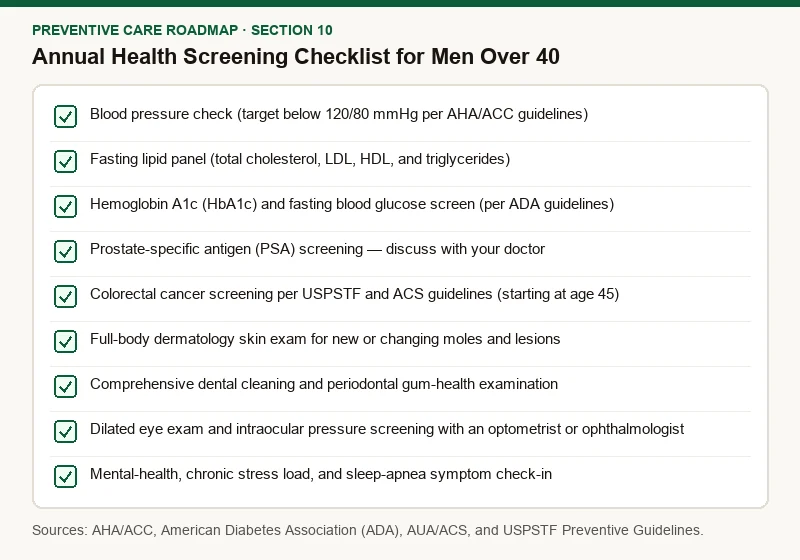
- ☐ Measure seated resting blood pressure (bring a 1-week home log if previously above 120/80 mmHg).
- ☐ Order a fasting lipid panel (total cholesterol, LDL-C, HDL-C, triglycerides, and ApoB if family risk is present).
- ☐ Order fasting blood glucose and Hemoglobin A1c (HbA1c) to screen for prediabetes.
- ☐ Measure waist circumference at the navel (target under 40 inches / 102 cm).
- ☐ Discuss age- and risk-appropriate PSA screening and report nighttime urinary changes.
- ☐ Review colorectal cancer screening options beginning at age 45 (USPSTF Grade A/B).
- ☐ Ask for a morning fasting total testosterone and 25-hydroxyvitamin D panel if clinically indicated.
- ☐ Report snoring, daytime fatigue, or morning headaches to evaluate for sleep apnea.
- ☐ Review all prescription medications, over-the-counter drugs, and supplements for interactions.
- ☐ Confirm vaccination status (annual influenza, tetanus booster, and shingles starting at age 50).
Key Takeaways: Men's Health After 40
- Cardiovascular risk is priority number one: Silent elevations in blood pressure, LDL cholesterol, and visceral fat drive long-term risk far more than age-related hormone shifts (CDC; AHA/ACC).
- Sarcopenia is preventable: Resistance training twice weekly paired with adequate protein (1.0–1.2+ grams per kilogram daily) halts the 1–2% annual muscle loss after age 50 (WHO/HHS; PROT-AGE).
- Prostate care splits into two tracks: BPH causes urinary symptoms without raising cancer risk, while early prostate cancer is silent and requires shared PSA decision-making starting at ages 40–55 by risk (AUA; ACS; USPSTF).
- Testosterone follows lifestyle first: Total testosterone declines ~1% annually after 40, and true hypogonadism requires both symptoms and two low morning fasting readings after sleep and visceral fat are addressed (Endocrine Society).
- Supplements cannot replace screening: Target only verified deficiencies or dietary gaps after establishing movement, nutrition, sleep, screening, and connection.
Your Annual Numbers Tracker (Print This)
- Resting blood pressure: target under 120 over 80 (AHA / ACC). Check your blood pressure after sitting quietly for five minutes with your feet flat on the floor and your arm supported at heart level. Because elevated blood pressure rarely causes noticeable symptoms in your 40s, logging home readings alongside your annual clinic measurement is one of the highest-return habits for long-term cardiovascular and vascular protection.
- Fasting lipid panel: track LDL cholesterol and triglycerides (AHA). A standard fasting lipid panel measures total cholesterol, LDL cholesterol, HDL cholesterol, and triglycerides to help estimate your 10-year atherosclerotic cardiovascular risk. Recording these numbers year over year lets you and your physician see how nutrition, waist-line changes, and resistance training move your lipid trajectory over time.
- Fasting glucose and HbA1c: keep HbA1c under 5.7 percent (ADA). While a single fasting blood glucose reading captures a one-morning snapshot, hemoglobin A1c reflects your average blood sugar exposure across the preceding two to three months. Catching an upward drift early—before it crosses into the prediabetes range—gives you time to intervene with strength training, sleep hygiene, and dietary fiber.
- Waist circumference: hold under 40 inches at the navel (NHLBI). Measure horizontally around your bare abdomen just above the hip bones at the level of your navel after a normal exhale, without pulling the tape tight. Waist circumference tracks visceral abdominal fat far more reliably than scale weight alone and correlates closely with insulin sensitivity, sleep apnea risk, and endogenous testosterone balance.
- Screening milestones: colorectal screening at 45 (USPSTF) and PSA discussion at 45. The U.S. Preventive Services Task Force recommends starting average-risk colorectal cancer screening at age 45 via colonoscopy or an approved stool-based test. Men at higher risk for prostate cancer—including Black men and men with a first-degree family history—should begin shared decision-making discussions about PSA blood testing at age 45, with average-risk discussions typically starting between 45 and 50.
Frequently Asked Questions
What is the most common health problem for men over 40?
Cardiovascular disease—specifically silent hypertension, elevated LDL cholesterol, and coronary atherosclerosis—is the leading health threat for men after 40, per the Centers for Disease Control and Prevention (CDC). Closely linked metabolic conditions, including visceral obesity and prediabetes, alongside benign prostatic hyperplasia (BPH) in the 50s, are the most common routine clinical findings.
At what age should a man start getting a prostate exam?
Screening timelines depend on individual risk. The American Urological Association (AUA) and American Cancer Society (ACS) recommend starting shared decision-making around PSA screening at ages 40 to 45 for higher-risk men (including Black men and those with a strong family history), age 50 for average-risk men (ACS), and ages 55 to 69 per the USPSTF.
How much does testosterone drop after 40?
According to the Endocrine Society, total serum testosterone declines gradually by roughly 1% per year after age 30 to 40, while free testosterone drops slightly faster because sex hormone-binding globulin (SHBG) rises with age. Most healthy men remain within normal reference ranges unless visceral obesity, sleep loss, or illness accelerates the decline.
How can a 40-year-old man get back in shape safely?
Start with a baseline primary-care checkup to verify resting blood pressure and cardiovascular history. Follow U.S. Department of Health and Human Services guidelines by building gradually toward 150 minutes per week of low-impact aerobic movement (brisk walking, cycling, or swimming) and two full-body resistance sessions per week focusing on controlled form.
What blood tests should a man over 40 get every year?
An annual or biennial preventive panel for men over 40 typically includes a fasting lipid profile (total cholesterol, LDL, HDL, triglycerides), fasting blood glucose and Hemoglobin A1c (HbA1c), a comprehensive metabolic panel (kidney and liver function), and a complete blood count, plus age-appropriate PSA or morning total testosterone assays when clinically indicated.
Why am I so tired in my 40s as a man?
Persistent fatigue in men over 40 is rarely caused by chronological age alone. Clinicians first evaluate modifiable medical causes: untreated obstructive sleep apnea, sleep duration under 7 hours, insulin resistance, hypothyroidism, vitamin D or B12 deficiency, anemia, chronic psychological stress or depression, medication side effects, and clinically verified hypogonadism.
How much protein does a man over 40 need per day?
While the minimum Recommended Dietary Allowance is 0.8 grams per kilogram of body weight daily, the international PROT-AGE Study Group recommends 1.0 to 1.2 grams of protein per kilogram of body weight per day for aging adults to counter anabolic resistance, and 1.2 to 1.6 grams per kilogram daily for men performing regular resistance training.
What are the best supplements for men over 40?
Evidence from the NIH Office of Dietary Supplements, AHA, and ISSN favors targeted, single-ingredient options matched to documented gaps rather than proprietary blends: vitamin D3 for lab-confirmed insufficiency, marine omega-3s (EPA/DHA) when fatty fish intake is low, magnesium for dietary shortfalls, creatine monohydrate alongside strength training, and protein powder for meal convenience.
Medical Disclaimer: This article is for informational and educational purposes only and does not constitute medical advice, diagnosis, or treatment. Always consult a qualified healthcare professional — your primary care physician, a cardiologist, a urologist, or an endocrinologist — before making changes to your diet, exercise routine, supplement regimen, or screening schedule, or if you have questions about a medical condition. Never disregard professional medical advice or delay seeking it because of something you have read on Pure Brand Reviews. If you are experiencing a medical emergency, call 911 or your local emergency number immediately.

