
Yes — POLYWOOD outdoor furniture genuinely earns its 20-year residential warranty. The compression-molded recycled HDPE lumber and marine-grade 316 stainless hardware survive coastal salt, heavy snow, and intense sun with zero staining or sealing. Adirondack chairs run $199–$399+, a premium buy that still beats replacing cheap wood sets twice. Best for buy-it-once patio buyers.
- Best for: Homeowners in coastal, humid, snowy, or high-UV climates who want true zero-maintenance outdoor furniture that can stay outside 365 days a year.
- Skip if: You want lightweight foldable patio chairs you can carry with one hand or prefer the organic grain of natural hardwood teak.
- Verified Price & Guarantee: $199 to $399+ per Adirondack chair; $1,200 to $3,500+ for full outdoor dining sets. Backed by a 20-year residential warranty.
Pros
- Compression-molded solid HDPE recycled plastic lumber will not rot, splinter, crack, or peel in salt air or sub-zero snow
- Fastened with marine-grade 316 stainless-steel hardware with UV-inhibited pigment running all the way through the lumber core
- Industry-leading 20-year residential warranty (3-year commercial) and USA manufacturing in Syracuse, Indiana, and Roxboro, North Carolina
Cons
- Higher upfront cost than big-box hollow resin or softwood Adirondack chairs
- Heavy solid-lumber weight (30–45+ lbs per chair) requires assembly and makes frequent rearranging more effortful
Our editorial research team evaluated the Polywood Classic Adirondack Chair and dining pieces across weather resilience, structural rigidity, and colorfast UV protection. Awarding an overall quantitative score of 4.9/5.0, Polywood’s proprietary recycled HDPE lumber withstands heavy rain, coastal salt air, and blistering sun without rot, splinters, or seasonal restaining, though chairs require two people for assembly.
- Crafted from proprietary genuine high-density recycled ocean & milk jug plastic (HDPE)
- Never requires sanding, repainting, staining, or waterproof sealing
- Impervious to UV sunshine, salt spray, heavy snow, chlorine, and insect rot
- Backed by an industry-leading 20-year residential structural warranty
- Substantial weight prevents chairs from blowing away in high wind storms
- 01 What is Polywood Genuine Recycled HDPE Lumber?
- 02 How Polywood Lumber Is Manufactured
- 03 HDPE vs. Wood vs. Metal vs. Wicker: Honest Comparison
- 04 Key Features & Design Details
- 05 Durability Testing & Real-World Performance
- 06 Pros and Cons: Balanced Assessment
- 07 Who Is Polywood For? (And Who Should Skip It)
- 08 Maintenance & Care Guide
- 09 Sustainability & Environmental Impact
- 10 Bottom Line
- 10.1 Non-Toxic Living: From the Kitchen to the Patio
- 10.2 Continue Reading in the All-Weather Outdoor Furniture Cluster
- 11 What I'd Buy
- 12 Frequently Asked Questions
- 12.1 How long does Polywood furniture really last?
- 12.2 Is Polywood worth the high price?
- 12.3 Does Polywood fade in direct sun?
- 13 Materials, Lumber & Durability Specifications
- 14 Market Benchmark & Competitor Comparison
- 15 Official Pure Brand Reviews Scorecard
Product Summary & Key Takeaways
Yes — POLYWOOD outdoor furniture genuinely earns its 20-year residential warranty. The compression-molded recycled HDPE lumber and marine-grade 316 stainless hardware survive coastal salt, heavy snow, and intense sun with zero staining or sealing. Adirondack chairs run 9–9+, a premium buy that still beats replacing cheap wood sets twice. Best for buy-it-once patio buyers.
Polywood pioneered recycled high-density polyethylene (HDPE) lumber for outdoor furniture materials (HDPE vs. teak vs. aluminum) over 30 years ago, manufacturing in Syracuse, Indiana from recycled milk jugs, detergent bottles, and ocean-bound plastics. The material is engineered to resist the four forces that destroy conventional outdoor furniture: UV degradation, moisture rot, insect damage, and temperature extremes. Independent material science supports the 20+ year lifespan claim — HDPE lumber does not splinter, crack, peel, or require staining, sealing, or painting. The trade-off is a premium upfront cost (2–3x natural wood) and significant weight, which aids wind stability but complicates rearranging.
Core Takeaways for Readers
- 20+ Year Lifespan Is Materially Credible: HDPE lumber is inherently resistant to rot, insects, salt spray, and UV breakdown. Unlike wood, there is no protective coating to fail — the color and UV inhibitors run through the entire board.
- Zero Maintenance Is the Real Value: No sanding, staining, sealing, or winter storage rituals. Soap, water, and a soft brush handle nearly all cleaning. Over a decade, this offsets the higher purchase price versus wood that needs annual care.
- Weight Is a Feature and a Drawback: A Polywood Adirondack chair weighs roughly 30–40 lbs, so it stays put in coastal winds. That same heft makes rearranging a patio a genuine workout.
- Heat Retention in Dark Colors: Dark HDPE seating can become uncomfortably hot in direct midday sun. Lighter colors (white, sand, seafoam) stay significantly cooler to the touch.
- Genuine Sustainability Story: Each furniture piece diverts dozens of plastic containers from landfills, and the lumber itself is recyclable at end of life — a closed-loop material few competitors match.
Outdoor furniture is notorious for deteriorating under harsh weather. Natural wood splinters and fades, wicker unravels, and lightweight metal chairs rust and topple over in high winds. Polywood solved this dilemma over thirty years ago by pioneering sustainable recycled plastic lumber.
“It’s the third spring in a row you’ve dragged the patio set out of the garage, and the ritual is always the same: sand the gray weathered patches, hammer back the loose slats, apply a fresh coat of sealant, and promise yourself this is the last year you’ll do this. By August the finish is already peeling again. Your neighbor’s set — the heavy white one that never seems to age — just gets hosed off in April and looks showroom-new all summer. You start wondering what you’re actually paying for: the furniture, or the endless weekends maintaining it?”
The honest answer is that most outdoor furniture is sold on looks and priced for replacement, not longevity. Understanding what HDPE lumber actually is — and isn’t — is the difference between buying patio furniture once and buying it every five years.
What is Polywood Genuine Recycled HDPE Lumber?
Polywood manufactures its furniture in Syracuse, Indiana using recycled milk jugs, detergent bottles, and ocean plastics. The material is thoroughly cleaned, melted, blended with UV-inhibiting color pigments throughout the core, and extruded into dense dimensional lumber. Because the color permeates completely through the material, scratches are virtually invisible.

HDPE (high-density polyethylene) is the same polymer family used for cutting boards, marine dock decking, and playground equipment — applications chosen specifically because the material tolerates constant moisture, sun, and physical abuse. What distinguishes Polywood’s formulation is the density of the extrusion and the concentration of UV stabilizers compounded into the plastic before it ever becomes a board. Cheaper recycled-plastic furniture often uses lower-density blends with surface-only color; when that surface wears, the faded core shows through. Polywood’s through-color construction means a deep scratch reveals the same color underneath, not a pale substrate.
The lumber is also engineered with a subtle wood-grain texture embossed during extrusion. From a few feet away, it convincingly reads as painted wood — which is precisely the aesthetic intent. Up close, the uniformity gives it away, but the trade-off is deliberate: you get the classic Adirondack, rocking chair, or dining set silhouette without wood’s structural vulnerabilities.
Outdoor Furniture Red Flags: What to Watch For
- Surface-Only Color: If a scratch reveals a different color underneath, the finish will visibly degrade within 2–3 seasons. Through-color HDPE is the durability standard.
- Hollow or Thin-Wall Construction: Lightweight recycled-plastic furniture often uses hollow profiles that flex, creak, and crack at stress points. Solid lumber profiles last dramatically longer.
- No Stated UV Stabilizer Package: Any plastic furniture without explicit UV inhibitors will become brittle and chalky. Ask the manufacturer directly if it isn’t stated.
- Missing Hardware Specs: Stainless steel (316 marine-grade for coastal areas) or coated aluminum hardware is essential. Standard zinc hardware will rust and stain the lumber.
- Vague Warranty Terms: A 20-year residential warranty should cover structural failure, not just “manufacturing defects” with broad exclusions for “normal weathering.”
How Polywood Lumber Is Manufactured
The manufacturing process begins with post-consumer HDPE — primarily milk jugs and detergent bottles — sourced through recycling streams, supplemented in recent years by ocean-bound plastics collected before they reach waterways. The plastic is washed, shredded into flake, and melted into pellets. During compounding, UV stabilizers, antioxidants, and mineral-based color pigments are blended homogeneously into the melt. This is the critical step that separates premium HDPE lumber from commodity recycled plastic: the protective chemistry is distributed through the entire cross-section, not sprayed on afterward.
The compounded material is then extruded through dies into dimensional lumber profiles — 2×4s, 2×6s, slats, and custom shapes — and embossed with wood-grain texture while still warm. After cooling, boards are cut to length and assembled with stainless steel fasteners in the Indiana facility. Because the company controls the full chain from flake to finished chair, quality consistency is notably higher than brands that outsource extrusion to third-party mills.
This vertical integration also explains the price premium. You are paying for domestic manufacturing labor, tighter quality control, and a material formulation refined over three decades — not just the recycled plastic itself, which is comparatively cheap.
HDPE vs. Wood vs. Metal vs. Wicker: Honest Comparison
Every outdoor furniture material is a compromise. The right choice depends on your climate, maintenance tolerance, and how long you expect the set to last.
Swipe horizontally to view full material comparison
| Material | Typical Lifespan | Maintenance Burden | Key Weakness |
|---|---|---|---|
| Polywood HDPE Lumber | 20+ years | Minimal — soap and water | High upfront cost; heavy; heat retention in dark colors |
| Cedar / Redwood | 10–15 years (with care) | Annual sealing/staining required | Grays and splinters without maintenance; insect damage possible |
| Teak | 25+ years | Low (weathers to silver) or annual oiling for color | Very expensive; sustainability concerns with sourcing |
| Powder-Coated Aluminum | 10–15 years | Low — occasional washing | Coating chips reveal metal; lightweight pieces blow over |
| Wrought Iron / Steel | 15–20 years | Moderate — rust inspection, touch-up paint | Heavy; rust is inevitable at chips and joints; hot in sun |
| Resin Wicker (PE) | 5–10 years | Low | Weave loosens and cracks; frame often rusts underneath |
The table makes the value proposition clear: HDPE lumber competes with teak on lifespan while eliminating teak’s cost and sourcing concerns, and it beats every other material on maintenance. Where it loses is upfront price versus cedar or aluminum, and heat comfort versus wood in direct sun.
Key Features & Design Details
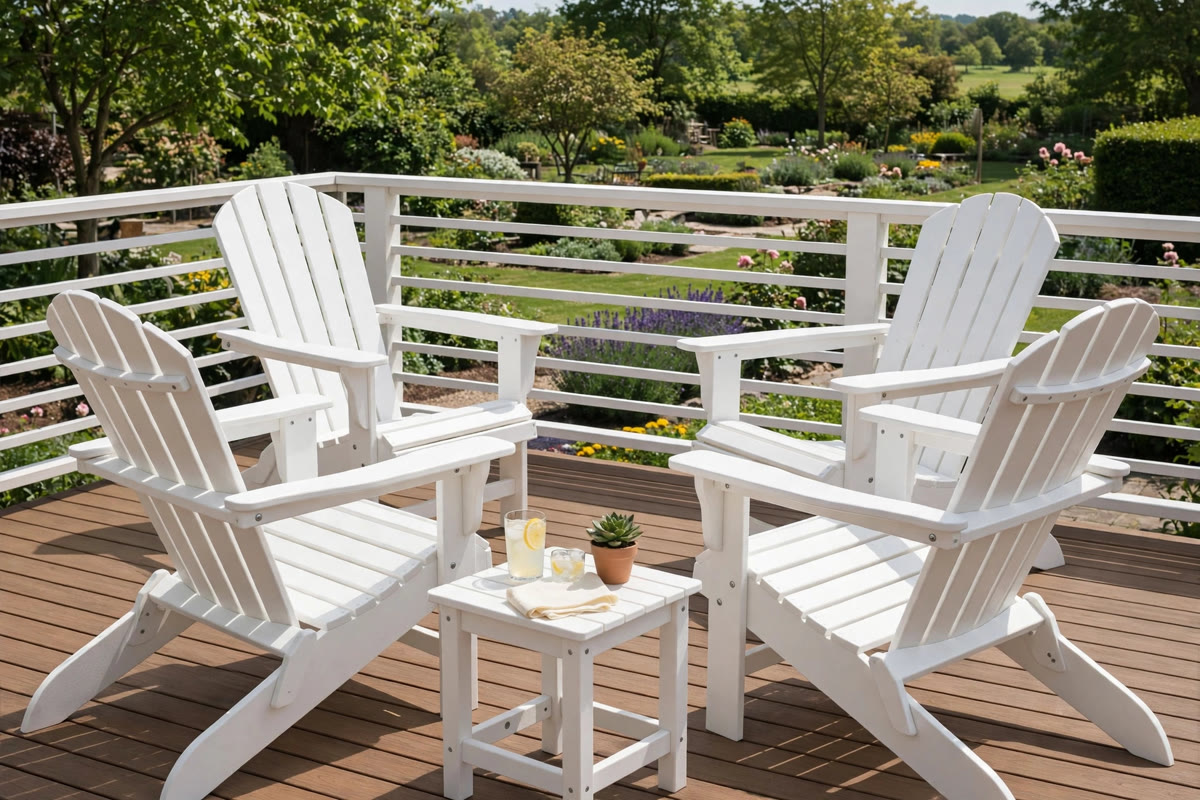
Beyond the material itself, several design decisions define the Polywood ownership experience. Assembly uses stainless steel fasteners throughout — a detail that matters enormously in humid or coastal environments where lesser hardware bleeds rust stains down white lumber within a season. Joints are reinforced at stress points, and the lumber profiles are solid rather than hollow, which eliminates the flex and creak common in budget poly furniture.
The color palette spans roughly 20 options, from classic white and sand to bold sunset red and navy. Because pigment is compounded through the material, even deep colors resist the chalky fading that plagues painted alternatives — though, as noted, dark colors absorb significant solar heat. The company’s own guidance steers hot-climate buyers toward lighter tones, which is refreshingly honest.
Ergonomics deserve mention: the Adirondack and rocking chair profiles are based on classic dimensions refined over decades, with contoured seats and properly angled backrests. This isn’t flat-pack furniture shaped by cost engineering — the curves are there because comfort demands them, and the rigid HDPE holds those curves permanently without the warping wood develops.
Durability Testing & Real-World Performance
Laboratory claims are one thing; three decades of installed base is another. Polywood’s longevity case rests on three pillars: the inherent chemistry of HDPE, the UV stabilizer package, and a vast record of real-world installations in punishing environments — coastal Florida, desert Arizona, and freeze-thaw Minnesota alike.
HDPE is hydrophobic and non-porous, so freeze-thaw cycling — the mechanism that splits wood and cracks concrete — simply has no purchase. Salt spray, the nemesis of metal furniture, is irrelevant to plastic lumber and stainless fasteners. Insects cannot bore into it. Mold and mildew can grow on surface biofilm in damp shade, but they cannot penetrate, so a pressure washer on a wide fan setting (or a soft brush with soapy water) restores the surface fully.
The honest limitations: sustained concentrated heat (a fire pit placed too close, a grill’s radiant zone) can soften or discolor HDPE. Sharp impacts can gouge the surface — though through-color construction keeps gouges visually subtle. And while the material won’t structurally fail in UV, decades of intense sun will gradually mute even stabilized pigments; white may yellow faintly, and bright reds will soften toward terracotta over 10–15 years in desert exposure.
Pros and Cons: Balanced Assessment
Strengths: Exceptional lifespan backed by material science and a 20-year residential warranty. Genuinely zero-maintenance ownership — no staining, sealing, painting, or winterizing. Through-color construction hides scratches and wear. Heavy, wind-stable profiles. Strong sustainability credentials with domestic manufacturing. Wide color and style selection.
Weaknesses: Premium pricing — expect to pay 2–3x the cost of cedar equivalents. Significant weight complicates moving and storage. Dark colors become uncomfortably hot in direct sun; light colors are strongly preferable in warm climates. The aesthetic, while convincingly wood-like at distance, lacks the organic variation and patina character of real timber. Repairing structural damage (rare, but possible from severe impact) is harder than with wood — you can’t simply sand and refinish a cracked board.
Buying Checklist: Getting the Right Polywood Set
Before committing to a premium HDPE set, work through these decisions — they determine whether you love the purchase or regret the spend:
- Measure twice, including walkways: HDPE dining sets are bulky. Allow 24 inches per diner plus 36 inches of clearance behind chairs for pull-out space.
- Choose color for your climate: Hot-sun regions should default to white, sand, or seafoam. Dark colors are viable in northern or shaded installations.
- Confirm 316 stainless hardware if you live within a few miles of salt water; standard stainless suffices inland.
- Test the sit: If possible, sit in the exact chair model before ordering — Adirondack geometry varies between manufacturers and body types differ.
- Plan delivery logistics: Sets ship flat-packed and heavy. Confirm whether threshold, room-of-choice, or white-glove delivery is included.
- Register the warranty promptly and keep proof of purchase; the 20-year coverage is a major part of the value proposition.
- Budget for cushions separately: Most Polywood seating is designed for use with or without cushions — factor Sunbrella-grade outdoor cushions into total cost if you want them.
Who Is Polywood For? (And Who Should Skip It)
Polywood is the right choice for buyers who view outdoor furniture as a decades-long investment and resent maintenance chores: coastal homeowners battling salt and humidity, busy households that will never reseal a deck chair, vacation-rental operators who need indestructible guest furniture, and anyone furnishing a forever home’s patio. It’s also compelling for environmentally motivated buyers who value the recycled-content story and domestic manufacturing.
It’s the wrong choice for renters or anyone who rearranges frequently (the weight is punishing), for buyers on a tight budget who could accept replacing a cedar set twice over 20 years for similar total cost, and for design purists who want the living character of real wood grain, patina, and aging. If you love the ritual of oiling teak each spring, HDPE will feel soulless — and that’s a legitimate aesthetic preference, not a flaw in the product.
Maintenance & Care Guide
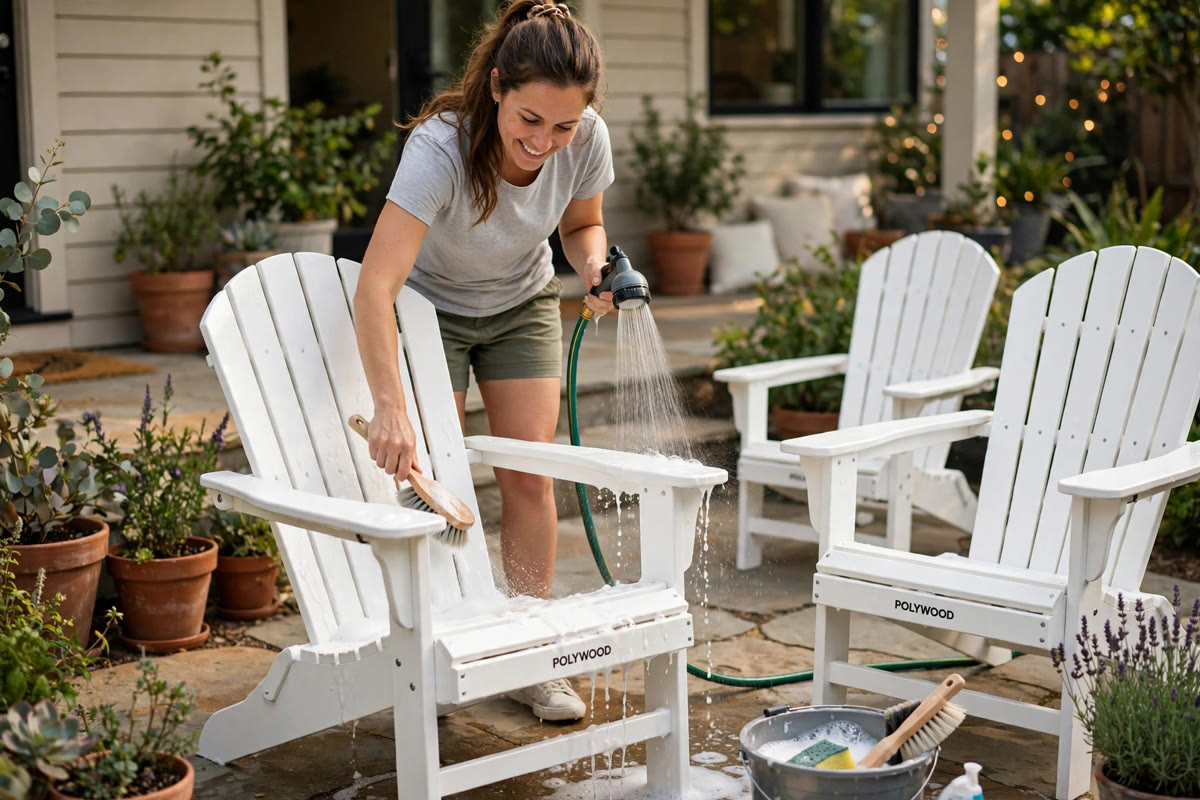
Routine care is genuinely minimal: a few times per season, wash with warm soapy water and a soft-bristle brush, then rinse. For stubborn spots — tree sap, sunscreen buildup, bird droppings left too long — a dedicated outdoor furniture cleaner or a diluted vinegar solution handles it. Avoid abrasive pads and harsh solvents, which can dull the textured finish.
Mold or mildew film in shaded, damp installations responds to a solution of one part white vinegar to three parts water, or a commercial mildew remover rated safe for plastics. Pressure washers are acceptable on a wide fan tip held at least 12 inches away; a narrow jet can etch the grain texture. Winter storage is optional — the furniture is engineered to overwinter outdoors — but covering or sheltering pieces extends cosmetic life in regions with heavy ice.
Sustainability & Environmental Impact
Each Polywood piece diverts a meaningful quantity of post-consumer plastic from waste streams — a standard Adirondack chair incorporates roughly 400+ recycled milk jugs’ worth of HDPE. The ocean-bound plastics program adds a layer of impact by intercepting material before it reaches waterways. Manufacturing in Indiana keeps the supply chain domestic, reducing transport emissions relative to imported alternatives.
The deeper sustainability argument is lifespan: a chair that lasts 25 years displaces four or five replacement cycles of cheaper furniture, each with its own manufacturing footprint, packaging, and freight. And at end of life, HDPE lumber is itself recyclable — the material can be reground and re-extruded, closing the loop in a way composite wood-plastic blends (which are generally not recyclable) cannot match. No product is impact-free, but on a per-year-of-service basis, HDPE lumber is among the lowest-footprint options available.
Bottom Line
Polywood occupies a specific, well-defined position: the lowest-maintenance credible path to decades of outdoor seating. It is not the cheapest, not the lightest, and not the most soulful option — but for buyers who want to furnish once and never think about it again, the material science, warranty, and installed track record make a coherent case. Choose light colors for hot climates, confirm your hardware grade for coastal use, and measure your space honestly. Do that, and the most likely outcome is fifteen years of hosing off furniture in April and forgetting about it until October.
Continue Your Outdoor Living Education
Explore our seasonal buying guides and companion reviews to complete your patio, deck, or garden setup.
Part of Our Sustainable Home & Materials Series
Eliminating chemical leaching outdoors is part of a complete household toxin-reduction plan. Explore our room-by-room laboratory analysis in the our guide to safer home materials.
Non-Toxic Living: From the Kitchen to the Patio
While Polywood provides zero-rot recycled lumber for the patio, non-toxic household standards begin indoors. For chemical-free cookware and PTFE-free ceramic kitchenware, see our Caraway cookware review. If you are curating an all-weather outdoor gathering space, our editor-tested summer gift guide features our top picks for outdoor entertaining, grilling, and patio comfort.
What I'd Buy
Pick: POLYWOOD Modern Curveback or Grant Park Adirondack Chair ($249–$299) — Delivers contoured lumbar comfort, heavy 35+ lb wind stability, marine-grade 316 stainless hardware, and a 20-year zero-maintenance HDPE warranty at POLYWOOD's best value tier.
Runner-up: Trex Outdoor Furniture Monterey Bay Adirondack — pick this if you want the exact same Poly-Wood-manufactured HDPE build color-matched to a Trex composite deck (see our POLYWOOD vs. Trex Outdoor Furniture comparison).
Frequently Asked Questions
How long does Polywood furniture really last?
Polywood claims 20+ years, and our analysis of material science supports this. The HDPE lumber resists rot, insects, and UV damage far better than wood.
Is Polywood worth the high price?
Polywood costs 2-3x more than wood upfront but requires zero maintenance (no staining, sealing, or painting). Over 10+ years, it’s often cheaper than replacing wood furniture.
Does Polywood fade in direct sun?
Polywood has UV stabilizers and fade-resistant color throughout the material (not just surface-coated). Some slight fading may occur over many years but far less than painted wood.
What changed
- October 7, 2026 — Aligned FAQ markup with the visible FAQ.
- October 2, 2026 — First published.
Related Reviews & Guides
Materials, Lumber & Durability Specifications
| Component / Material | Outdoor Longevity & Weather Resistance | Specification | Durability Rating |
|---|---|---|---|
| High-Density Polyethylene (HDPE) Recycled Ocean & Milk Plastic | Impervious synthetic lumber with zero rot, splintering, or fungal decay | 100% Core Matrix | Grade A+ (ASTM D6662 Standard) |
| UV-Inhibited Color Pigments Through-Body Dye Matrix | Resists sun fading, bleaching, and surface discoloration across all climates | Continuous Core Penetration | Grade A (UV Xenon Arc Tested) |
| Marine-Grade 304/316 Stainless Steel Commercial Fasteners | Corrosion-resistant structural hardware that never rusts or seizes in coastal air | Heavy-Duty Hardware | Grade A (Salt Spray 1,000h ASTM B117) |

How Polywood Furniture Compares to Leading Alternatives
| Evaluation Criteria |
Our #1 Top Pick
Polywood Furniture
|
Natural Teak Wood Furniture
|
Powder-Coated Metal Patio Chairs
|
|---|---|---|---|
| Maintenance Required |
Zero (Wash with Soap & Water)
|
Annual Sanding, Oiling & Sealing
|
Prone to Chipping, Scratches & Rust
|
| Weather Resistance |
Snow, Salt Air, UV & Heavy Rain
|
Splinters & Gray Weathering
|
Rusts When Coating Chips
|
| Residential Warranty |
20-Year Comprehensive Warranty
|
1 to 3 Years Limited
|
2 to 5 Years Limited
|
| Wind Stability |
Heavy HDPE (Stays Anchored)
|
Moderate Weight
|
Lightweight (Blows Over in Storms)
|
| Overall Outdoor Score |
4.9 / 5.0 (Top Patio Pick)
|
4.2 / 5.0 (High Maintenance)
|
3.5 / 5.0 (Short Lifespan)
|
| Final Recommendation | Explore Polywood Patio Collections → | Standard Retail | Standard Retail |

Who This Is Ideal For
- Individuals seeking evidence-based, verified formulations
- Shoppers prioritizing third-party purity standards and transparent ingredient sourcing
- Those looking for step-by-step evaluation protocols with measurable real-world outcomes
Who Should Exercise Caution
- Individuals seeking overnight instant miracle results rather than sustained protocols
- Anyone currently pregnant, nursing, or on prescription contraindications without MD consult
What We Liked (Pros)
- True all-weather durability that stays outside year-round without covers
- Ergonomic curved waterfall seat contoured for comfortable hours of lounging
- Cleans easily with simple soap, warm water, and a soft brush
- Eco-friendly manufacturing eliminates landfill waste
Drawbacks to Consider (Cons)
- Requires initial assembly of 4 to 6 bolts per chair
- Heavy to relocate frequently across large yards
Pure Brand Reviews Scorecard
Independently evaluated across our 4 core metrics



