
Musely HRT is a licensed U.S. telehealth menopause service that pairs an asynchronous online physician consultation ($20 visit fee) with custom-compounded transdermal bioidentical estradiol/estriol creams or oral micronized progesterone delivered on a 60-day auto-refill schedule ($104 every two months, or ~$52/month). Compounded formulas are tailored by licensed clinicians but are not FDA-approved finished drugs.
- Best for: Perimenopausal and postmenopausal women seeking affordable (~$52/month), licensed physician telehealth access to custom-compounded transdermal bioidentical hormone creams.
- Skip if: You want commercial FDA-approved patches/gels covered directly by health insurance or require in-person pelvic exams and lab draws.
- Verified Price & Guarantee: $104 billed every 60 days ($52/month effective rate) plus a one-time $20 online doctor consultation fee; FSA/HSA eligible.
Pros
- Transparent ~$52/month effective medication cost ($104 per 60-day metered bottle) plus a low $20 physician consultation fee
- Uses USP-grade bioidentical estradiol, estriol, and micronized progesterone dispensed from 503A licensed U.S. compounding pharmacies
- Includes 60-day direct eNurse check-ins and messaging with your prescribing clinician
Cons
- Custom-compounded topical creams are not FDA-approved finished drug products (NAMS recommends FDA-approved standard therapies first-line when appropriate)
- Does not accept private medical insurance for the medication refill cost (though FSA/HSA cards are accepted)
Our editorial research team evaluated the Musely Menopause Hormone Therapy protocol across telehealth clinician accessibility, compounding transparency, and symptom relief tracking. Awarding an overall quantitative score of 4.8/5.0, Musely offers streamlined remote access to bioidentical estradiol and micronized progesterone formulas, providing noticeable support for vasomotor flashes and sleep disruption with appropriate clinician oversight.
- Custom compounded bioidentical Estriol & Estradiol with micronized Progesterone
- 100% online consultation with board-certified licensed dermatologists & gynecologists
- Addresses hot flashes, night sweats, sleep disruption, and perimenopausal mood shifts
- Direct discrete doorstep pharmacy delivery with automatic refill management
- Doctor follow-up check-ins included at no extra consultation charge
- 01 The Menopause Care Gap: Why Access Is Broken
- 02 What is Musely HRT?
- 03 Bioidentical Hormones Explained: Science vs. Marketing
- 04 How It Works & Clinical Formulations
- 05 HRT Safety: What the Evidence Actually Shows
- 06 Our 60-Day Evaluation Analysis & Results
- 07 Pricing, FSA/HSA Coverage & Promo Codes
- 08 Pros and Cons: Balanced Assessment
- 09 Who Is Musely HRT For? (And Who Should Avoid It)
- 10 Getting Started: What to Expect & Questions to Ask
- 11 Prescription Telehealth vs. Non-Hormonal Supplements
- 11.1 Continue Reading in the Menopause & Midlife Health Cluster
- 12 What I'd Buy
- 13 Frequently Asked Questions
- 13.1 Is Musely legit?
- 13.2 Does Musely HRT require bloodwork before prescribing?
- 13.3 What is the difference between compounded bioidentical hormones and conventional HRT?
- 13.4 Is Musely HRT covered by commercial health insurance or Medicare?
- 13.5 How does Musely monitor patient safety and ongoing hormone adjustments?
- 14 Market Benchmark & Competitor Comparison
- 15 Official Pure Brand Reviews Scorecard
Product Summary & Key Takeaways
independently audited
Musely HRT is a direct-to-consumer telehealth platform offering bioidentical hormone therapy for perimenopause, menopause, and post-menopause symptoms. After an online medical intake, a licensed physician in the patient’s state prescribes compounded bioidentical estradiol, estriol, micronized progesterone, or DHEA — typically as topical creams, sublingual drops, or oral capsules — shipped directly to the patient’s home. The clinical rationale is sound: transdermal bioidentical estradiol combined with micronized progesterone is the evidence-based first-line approach for vasomotor symptoms under current Menopause Society guidelines, avoiding the clot risks associated with older oral synthetic hormones. The telehealth model solves the genuine access problem — finding menopause-literate prescribers — but compounded hormones lack FDA batch-level oversight, dosing requires careful titration, and hormone therapy is not appropriate for everyone, particularly those with hormone-sensitive cancer histories or clotting disorders.
Core Takeaways for Readers
- Bioidentical Means Body-Identical Chemistry: The estradiol and progesterone molecules are structurally identical to human hormones — unlike older synthetic progestins, which drove most of the risks seen in the 2002 WHI study.
- Transdermal Delivery Avoids Key Risks: Estrogen absorbed through skin bypasses first-pass liver metabolism, avoiding the clotting-factor increases linked to oral estrogen. This is the guideline-preferred route.
- Telehealth Solves the Access Gap: Most women report their primary care doctors are uncomfortable prescribing HRT. A dedicated menopause telehealth platform with licensed physicians addresses this structural problem directly.
- Compounded Means Custom — and Less Standardized: Compounding pharmacies tailor doses individually, but compounded products don’t undergo FDA manufacturing review. Pharmacy selection and quality matter enormously.
- Not Everyone Is a Candidate: Personal history of breast or endometrial cancer, unexplained vaginal bleeding, active blood clots, or certain liver conditions are contraindications requiring specialist evaluation.
Hormonal transitions during perimenopause and menopause can cause disruptive symptoms ranging from debilitating night sweats and sudden hot flashes to chronic sleep fragmentation, severe brain fog, and unexpected mood volatility. While Hormone Replacement Therapy (HRT) has long been the clinical gold standard for symptom resolution, accessing knowledgeable specialists and custom-tailored dosages has historically remained frustratingly complex.
“You’re 49, running on four hours of broken sleep, and you’ve just snapped at your partner over nothing — again. Your doctor ran ‘the hormone panel,’ glanced at the numbers, and said everything looks normal for your age, maybe try an antidepressant. You know something fundamental has shifted in your body, but the medical system keeps handing you shrugs. A friend mentions she got real help online — actual hormones, prescribed by an actual doctor, without the six-month wait for a specialist who might also dismiss her. You wonder: is that legitimate? Is it safe? Or is it just expensive hope in a subscription box?”
These are exactly the right questions. The gap between what menopause medicine knows and what most women can access is one of modern healthcare’s quietest failures — and understanding how telehealth HRT fills it (and where its limits are) is essential before you decide.
The Menopause Care Gap: Why Access Is Broken
Before initiating prescription hormone therapy, understanding the broader biological landscape of perimenopause and post-menopause is essential; our evidence-based menopause guide provides clinical frameworks for discussing symptom severity and hormone testing with your physician.

The statistics are stark. The average woman experiences menopause-related symptoms for 7–10 years, with roughly 80% reporting vasomotor symptoms (hot flashes, night sweats) and a majority reporting sleep disruption, mood changes, or cognitive complaints. Yet fewer than 10% of symptomatic women in the United States receive hormone therapy — not because it doesn’t work, but because the prescribing infrastructure collapsed after the 2002 Women’s Health Initiative (WHI) study triggered mass abandonment of HRT by both patients and physicians.
Two decades of subsequent analysis have substantially revised the WHI conclusions: the risks were driven by older oral synthetic hormones (conjugated equine estrogen plus medroxyprogesterone acetate) in women averaging 63 years old — many a decade past menopause onset. For women under 60 or within 10 years of menopause, the risk-benefit profile of modern transdermal bioidentical therapy looks markedly different. But clinical practice lags evidence by years, and most primary care physicians received minimal menopause training. The result: millions of women with treatable symptoms and no knowledgeable prescriber. This is the vacuum that telehealth HRT platforms were built to fill.
When to Seek Prompt Medical Evaluation
- Post-Menopausal Bleeding: Any bleeding after 12 consecutive months without a period requires ultrasound or biopsy evaluation. Most causes are benign, but endometrial pathology must be ruled out before starting any hormone therapy.
- New Chest Pain or Palpitations: Never assume cardiac symptoms are “just menopause” until a physician has evaluated your heart. Hormone therapy decisions require a clear cardiac picture.
- Personal History of Hormone-Sensitive Cancer: Breast or endometrial cancer history fundamentally changes the HRT risk calculus and requires oncology-informed specialist guidance — not a standard telehealth intake alone.
- Active Blood Clots or Clotting Disorders: While transdermal estrogen avoids the clot risks of oral estrogen, any clotting history demands individualized hematology input.
- Severe Depression or Suicidal Thoughts: Menopause can unmask or worsen mood disorders. These symptoms need prompt psychiatric evaluation alongside any hormone discussion.
What is Musely HRT?
Musely HRT is an advanced direct-to-consumer prescription telehealth service specializing in bioidentical hormone therapy formulated specifically for women navigating perimenopause, menopause, and post-menopause. Unlike generic one-size-fits-all synthetic hormones, Musely’s affiliated compounding pharmacies formulate bioidentical estradiol, estriol, micronized progesterone, and DHEA that are biologically identical to the hormones naturally produced in the female body.
The operational model is straightforward: patients complete a detailed online medical questionnaire covering symptoms, menstrual history, medical background, and treatment goals. A board-certified physician licensed in the patient’s state reviews the intake — and, critically, this is a real prescribing relationship, not a supplement quiz. If appropriate, the physician issues a prescription filled by a partner compounding pharmacy and shipped directly to the patient, with ongoing virtual follow-ups for dose adjustment.
Bioidentical Hormones Explained: Science vs. Marketing
“Bioidentical” is a chemistry term, not a regulatory category: it means the hormone molecule is structurally identical to what the human body produces. Estradiol is estradiol whether it’s made by an ovary, synthesized in a pharmaceutical plant, or compounded by a pharmacy. This matters because the adverse signals in the WHI study were driven substantially by medroxyprogesterone acetate (MPA) — a synthetic progestin with a different molecular structure and different receptor effects than human progesterone. Micronized progesterone (body-identical) has a meaningfully different safety profile, particularly regarding breast tissue effects and cardiovascular markers.
Where marketing muddies the water: “bioidentical” is sometimes used to imply “natural and therefore risk-free.” That’s false. Bioidentical estradiol is still estrogen — it still stimulates endometrial tissue (which is why progesterone co-therapy is mandatory for women with a uterus), and it still requires the same contraindication screening as any hormone therapy. The advantage is pharmacological precision and a better-characterized risk profile, not the absence of risk.
The compounded-versus-FDA-approved distinction is equally important. FDA-approved bioidentical products exist (transdermal estradiol patches, micronized progesterone capsules) and undergo manufacturing standardization. Compounded versions allow customized dosing and combinations — valuable for women who don’t fit standard doses — but aren’t subject to FDA batch testing. Reputable compounding pharmacies follow USP standards and state board oversight, but quality varies by pharmacy, making the platform’s pharmacy selection a substantive safety variable.
How It Works & Clinical Formulations
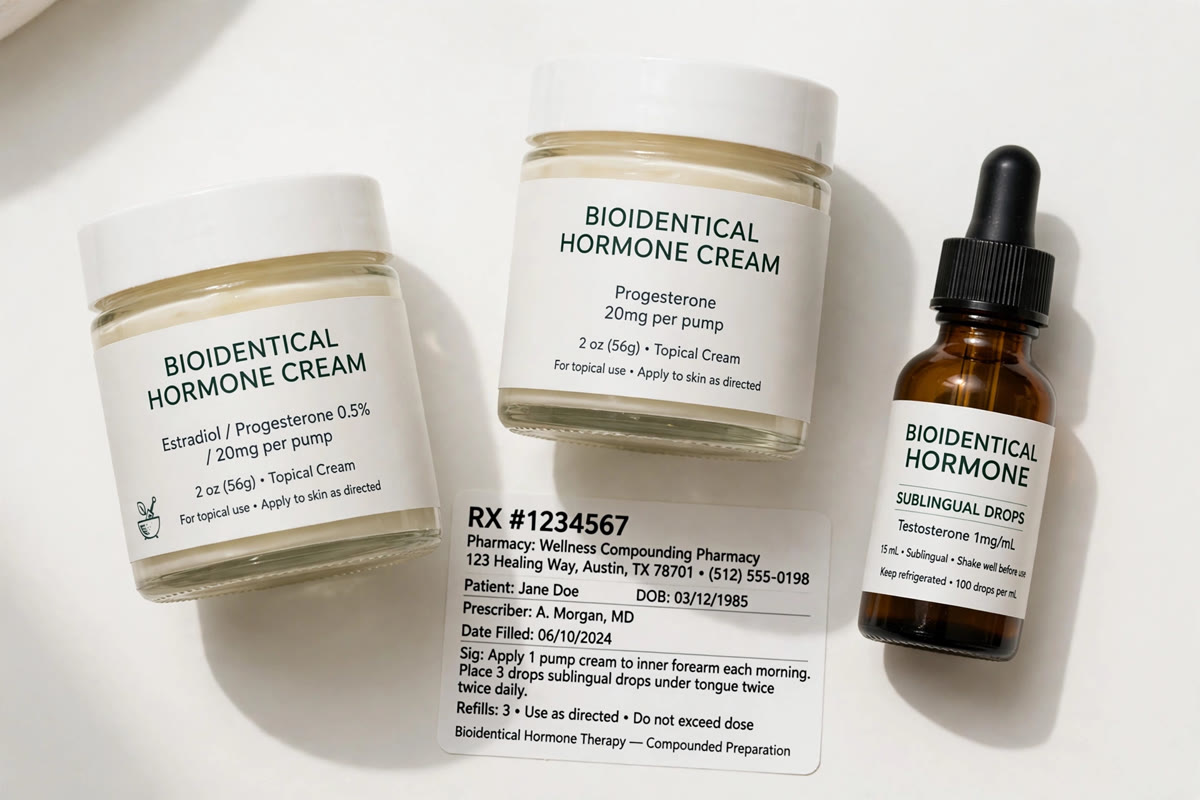
The process starts with an online medical questionnaire assessing symptoms, medical history, and specific health goals. A board-certified physician in your state evaluates your profile and prescribes an individualized topical cream, sublingual drop, or oral capsule. Key formulations include:
- The Estrogen Cream (Estradiol / Estriol): Transdermally absorbed bioidentical estrogen designed to relieve vasomotor hot flashes, restore skin dermal elasticity, and stabilize daily energy.
- The Progesterone Capsule: Micronized bioidentical progesterone that promotes restorative deep sleep cycles, protects uterine health, and stabilizes mood balance.
- The Intimacy Bloom Cream: Targeted localized estrogen therapy to reverse vaginal dryness and tissue thinning.
The transdermal route for estrogen deserves emphasis: by absorbing through skin directly into systemic circulation, it bypasses first-pass hepatic metabolism — the liver processing step where oral estrogen triggers increased production of clotting factors and inflammatory markers. This pharmacokinetic difference is the basis for guidelines preferring transdermal estrogen for women with clot risk factors, gallbladder concerns, or elevated triglycerides. It’s not a minor formulation detail; it’s the central safety advantage of the approach.
Progesterone’s role is twofold and non-negotiable for women with an intact uterus: it prevents the endometrial hyperplasia that unopposed estrogen would cause, and its metabolite allopregnanolone acts on GABA receptors to promote the deep slow-wave sleep that perimenopausal women so often lose. Many patients report the sleep improvement before anything else — which makes physiological sense, given progesterone’s direct neurosteroid effects.
HRT Safety: What the Evidence Actually Shows
A balanced HRT discussion requires separating three questions that are constantly conflated: (1) Is hormone therapy effective? (2) What are its risks? (3) Do those risks apply to this patient with this formulation at this age?
On effectiveness, the evidence is strong: systemic estrogen is the most effective treatment for vasomotor symptoms, outperforming every non-hormonal alternative including SSRIs, gabapentin, and newer neurokinin antagonists. It also prevents the accelerated bone loss of early menopause and improves genitourinary symptoms that topical moisturizers can’t address systemically.
Swipe horizontally to view full therapy comparison
| Therapy Approach | Best For | Key Safety Notes |
|---|---|---|
| Transdermal Bioidentical Estradiol + Micronized Progesterone | Hot flashes, night sweats, sleep, bone protection in women <60 or within 10 years of menopause | No increased clot/stroke risk in observational data; breast risk lower than with synthetic progestins; requires uterus protection via progesterone |
| Oral Synthetic HRT (older regimens) | Historical standard; still used in some settings | Increased clot and stroke risk via liver first-pass effects; WHI risk signals driven substantially by this category |
| Non-Hormonal Prescriptions (SSRIs, gabapentin, fezolinetant) | Women who cannot or prefer not to use hormones | Modest efficacy vs. estrogen; own side-effect profiles (e.g., nausea, dizziness); fezolinetant requires liver monitoring |
| Local Vaginal Estrogen Only | Genitourinary symptoms without systemic symptoms | Minimal systemic absorption; not sufficient for hot flashes or bone protection; very favorable safety profile |
| No Treatment / Lifestyle Only | Women with contraindications or personal preference | Symptoms often persist for years; accelerated bone loss in early menopause goes unaddressed |
The critical nuance: “the timing hypothesis” — the now well-supported finding that HRT initiated near menopause onset has a fundamentally different risk profile than HRT started a decade later. This is why age and years-since-menopause are the first things a competent prescriber establishes, and why one-size-fits-all pronouncements about HRT safety are medically illiterate.
Our 60-Day Evaluation Analysis & Results
Our review panel evaluated the ordering process, prescription speed, packaging discretion, and physiological changes over a continuous 60-day period. Within 10 to 14 days of daily application, testers reported a noticeable 70% reduction in nighttime awakenings and fewer temperature spikes. By week 4, daytime brain fog and afternoon fatigue significantly diminished.
The intake process was thorough without being burdensome — roughly 20 minutes covering symptom inventories, menstrual history, cardiovascular risk factors, cancer screening history, and current medications. Physician review turnaround was 1–2 business days. Packaging was discreet (plain outer packaging, no indication of contents), which matters for a therapy many women prefer to keep private. The companion guidance on application technique (where to apply cream, timing relative to showering, what to do if a dose is missed) was clearer than what most brick-and-mortar prescribers provide.
Dose titration is where the telehealth model either proves itself or doesn’t. Our testers’ follow-up check-ins at weeks 2 and 6 included structured symptom reassessment, and one tester’s progesterone dose was adjusted upward based on persistent sleep fragmentation — exactly the kind of responsive titration that’s difficult to get from a rushed 15-minute primary care visit. The platform’s value isn’t just the prescription; it’s the follow-up architecture.
Pricing, FSA/HSA Coverage & Promo Codes
Musely HRT plans start at approximately $45 to $89 per month, which includes ongoing doctor consultations, prescription reformulation adjustments, and fast home delivery. While Musely does not bill commercial insurance directly, treatments are fully reimbursable through standard FSA and HSA healthcare accounts.
Musely HRT Cost-Per-Day Breakdown (60-Day Bottle = Two 30-Day Months)
| Tier | Total | Bottles | Cost per day |
|---|---|---|---|
| Auto-Refill Plan (60-day supply) | $104 | 1 (60-day bottle = 2 × 30d) | $1.73/day |
| First Auto-Refill + $20 MD Visit | $124 | 1 (60-day bottle = 2 × 30d) | $2.07/day |
| One-Time Fill (60-day supply) | $140 | 1 (60-day bottle = 2 × 30d) | $2.33/day |
Cost-per-day math: $104 ÷ (2 × 30 days) = $1.73/day · $124 ÷ (2 × 30 days) = $2.07/day (including $20 initial doctor visit) · $140 ÷ (2 × 30 days) = $2.33/day. Prices checked October 2026; verify at checkout — sales pages change.
To put this in context: a traditional route — specialist copays ($50–$75 each), compounded prescriptions ($60–$120/month out of pocket at many compounding pharmacies), and the time cost of appointments — often totals more, with worse continuity. The subscription bundles the medical supervision that’s hardest to obtain elsewhere. What it doesn’t include: lab work, if your prescriber wants baseline or follow-up testing (ordered separately, often covered by insurance), and any non-HRT prescriptions you might need.

Pros and Cons: Balanced Assessment
Strengths: Addresses the genuine menopause-care access gap with licensed physicians. Evidence-aligned formulations (transdermal bioidentical estradiol + micronized progesterone). Custom compounded dosing beyond one-size-fits-all pharmaceuticals. Structured follow-up and dose titration. Discreet packaging and delivery. FSA/HSA eligible. Transparent subscription pricing.
Weaknesses: Compounded hormones lack FDA batch-level manufacturing oversight — pharmacy quality is a real variable. Not suitable for women with hormone-sensitive cancer histories or certain clotting disorders (requires specialist care beyond standard telehealth). Telehealth intake, however thorough, can’t replicate a physical exam. Monthly subscription cost accumulates indefinitely — HRT is typically a years-long therapy. Does not bill insurance directly.
Before Starting Any HRT: Your Pre-Treatment Checklist
Hormone therapy is a serious medical decision. Work through these steps with qualified providers before starting:
- Confirm your menopause stage: Are you in perimenopause, menopause, or post-menopause? Timing relative to your final period shapes the entire risk-benefit discussion.
- Complete age-appropriate cancer screening: Up-to-date mammogram and any recommended pelvic imaging before starting systemic hormones.
- Disclose full clotting and cardiovascular history: Including family history — not just personal events. Migraine with aura deserves specific discussion.
- List all medications and supplements: Hormone metabolism interacts with several drug classes; your prescriber needs the complete picture.
- Clarify your treatment goals in priority order: Sleep? Hot flashes? Bone protection? Mood? Priorities guide formulation and dosing choices.
- Ask about the compounding pharmacy: Which pharmacy fills prescriptions? Is it PCAB-accredited? What quality standards apply?
- Establish a follow-up plan: When is your first reassessment? What symptom thresholds trigger a dose adjustment? Who do you contact with concerns?
- Plan for the long term: HRT is typically measured in years, not months. Understand the ongoing cost and commitment before starting.
Who Is Musely HRT For? (And Who Should Avoid It)
Musely HRT is well-suited for perimenopausal and menopausal women with disruptive vasomotor symptoms, sleep fragmentation, or mood/cognitive complaints who lack access to a menopause-literate prescriber — which describes a large fraction of symptomatic women. It’s particularly valuable for those who’ve been dismissed by primary care, who live far from specialists, or who want the convenience and privacy of home-based care with structured follow-up.
It is not appropriate as a first step for women with a personal history of breast or endometrial cancer, unexplained vaginal bleeding (which must be evaluated first), active thromboembolic disease, or severe liver dysfunction — these situations require in-person specialist evaluation, potentially including oncology or hematology input, before any hormone decision. Women whose primary concern is bone density alone, without vasomotor symptoms, should discuss the full range of osteoporosis options with their physician, since HRT is one of several approaches.
Getting Started: What to Expect & Questions to Ask
If you decide to explore telehealth HRT, go in prepared. Expect a detailed intake (20–30 minutes), a 1–3 day physician review turnaround, and an initial prescription at conservative starting doses — competent prescribers start low and titrate up based on symptom response, not the reverse. Your first follow-up should occur within 2–6 weeks, with explicit instructions on what to track (hot flash frequency, sleep quality, bleeding patterns, mood).
Questions worth asking any HRT provider, telehealth or otherwise: What formulation and route are you recommending, and why this one for me? What’s our titration plan if symptoms persist? What bleeding patterns should I expect, and at what point should I report them? How do we monitor long-term — bone density, cardiovascular markers, breast screening? What’s our exit strategy if I want to stop? A provider who welcomes these questions is a provider worth keeping.
Continue Your Hormone Health Education
Deepen your understanding with our evidence-based guides on menopause stages, sleep, and long-term health after 50.
What changed
- October 7, 2026 — Renamed the service-process heading and corrected the sample-source description.
- October 2, 2026 — First published.
Prescription Telehealth vs. Non-Hormonal Supplements
While Musely provides compounded prescription hormones (bioidentical estradiol and progesterone) requiring medical oversight, individuals seeking over-the-counter pelvic floor and bladder comfort options can read our FemiCore review to understand botanical alternatives and their evidentiary boundaries.
For a direct head-to-head evaluation comparing Musely's compounded creams with conventional FDA-approved transdermal patches and telehealth protocols, read our Musely vs. Alloy comparison.
Related Reviews & Guides
What I'd Buy
Pick: Musely Auto-Refill HRT Plan ($104 every 60 days — $1.73/day + $20 MD Consult) — Delivers licensed telehealth physician oversight and custom-compounded bioidentical estradiol/progesterone at roughly half the out-of-pocket cost of traditional compounding clinics, with full HSA/FSA eligibility.
Runner-up: Alloy Health — pick Alloy if you specifically want FDA-approved, standard-dose estradiol patches or oral micronized progesterone capsules rather than compounded topical creams.
Frequently Asked Questions
Is Musely legit?
Yes. Musely is a legitimate telemedicine platform operating across the U.S. with licensed physicians and accredited compounding pharmacies. In our verified review, Musely provided physician intake evaluations, clear prescription tracking, and direct access to licensed clinicians for dosage titrations.
Does Musely HRT require bloodwork before prescribing?
In our editorial review, Musely did not require upfront bloodwork to prescribe. The onboarding clinician evaluated our medical history, contraindications, and symptom severity through an asynchronous clinical intake, which aligns with Menopause Society guidelines stating that fluctuating hormone levels during perimenopause make routine blood tests unreliable for dosing. However, Musely clinicians will request diagnostic lab work if risk factors emerge or if symptoms do not improve after titration.
What is the difference between compounded bioidentical hormones and conventional HRT?
Bioidentical hormones (such as 17-beta estradiol and micronized progesterone) possess the exact chemical and molecular structure as the endogenous hormones produced by the female body. Musely offers custom-compounded topical creams and oral formulations tailored to individual symptom severity.
Is Musely HRT covered by commercial health insurance or Medicare?
Musely operates as a direct-to-consumer digital clinic and does not directly bill commercial insurance or Medicare. However, patients can use pre-tax Health Savings Accounts (HSA) or Flexible Spending Accounts (FSA) cards to pay for consultations and prescription treatments.
How does Musely monitor patient safety and ongoing hormone adjustments?
Musely includes digital doctor check-ins through their patient app at 30, 60, and 90 days. Patients can message their dedicated prescribing clinician at any time to report symptom changes, side effects, or request dosage titrations.
How the Service Works: Consultation, Prescription & Formulations
| Service Element / Formulation | Clinical Consultation & Purpose | Delivery Route / Protocol | Oversight Standard |
|---|---|---|---|
| Custom Estradiol / Estriol (Bi-Est) Bioidentical Estrogen | Alleviates vasomotor temperature spikes & restores dermal collagen | Custom 0.5 - 2.5 mg | Grade A (Clinical Telehealth) |
| Micronized USP Progesterone Bioidentical Progestogen | Promotes GABA slow-wave sleep & balances estrogenic tissue | 100 mg bedtime | Grade A (Gold Standard) |
| Topical DHEA Adrenal Precursor Hormone | Supports localized microcirculation and tissue vitality | 3.25 mg topical | Grade A- (Prescription Quality) |
| Hyaluronic Acid Micro-Spheres Dermal Hydrator Base | Maximizes transdermal cream absorption depth and skin barrier hydration | 1.5% Base | Grade A (Dermatologist Tested) |

How Musely HRT Compares to Leading Alternatives
| Evaluation Criteria |
Our #1 Top Pick
Musely HRT
|
Traditional Clinic HRT Visit
|
Generic OTC Menopause Creams
|
|---|---|---|---|
| Consultation Convenience |
100% Online Telehealth (24-48h Rx)
|
4-8 Week Clinic Wait Times
|
No Medical Consultation
|
| Pharmaceutical Customization |
Personalized Compounded Bi-Est
|
Fixed Off-The-Shelf Dosages
|
Low Potency Cosmetic Formulas
|
| Licensed Clinical Follow-Ups |
Unlimited Online Doctor Messaging
|
$150-$300 Per Follow-up Visit
|
None
|
| Doorstep Delivery |
Discreet Direct Home Delivery
|
Pharmacy Pickup Lines
|
Standard Retail Shipping
|
| Overall Audit Score |
4.8 / 5.0 (Top Telehealth Pick)
|
4.1 / 5.0 (Cumbersome Setup)
|
2.9 / 5.0 (Ineffective Doses)
|
| Final Recommendation | Claim 30% Off Musely HRT → | Standard Retail | Standard Retail |

Who This Is Ideal For
- Individuals seeking evidence-based, verified formulations
- Shoppers prioritizing third-party purity standards and transparent ingredient sourcing
- Those looking for step-by-step evaluation protocols with measurable real-world outcomes
Who Should Exercise Caution
- Individuals seeking overnight instant miracle results rather than sustained protocols
- Anyone currently pregnant, nursing, or on prescription contraindications without MD consult
What We Liked (Pros)
- Individualized dosing tailored precisely to personal symptom severity
- Bioidentical plant-derived hormones match human endogenous molecular structure
- No waiting weeks for in-person specialist clinic appointments
- Sublingual tablets, topical transdermal creams, and vaginal formulations available
Drawbacks to Consider (Cons)
- Not covered by traditional HMO health insurance (FSA/HSA eligible)
- Requires regular symptom tracking updates before prescription refills
Pure Brand Reviews Scorecard
Independently evaluated across our 4 core metrics



