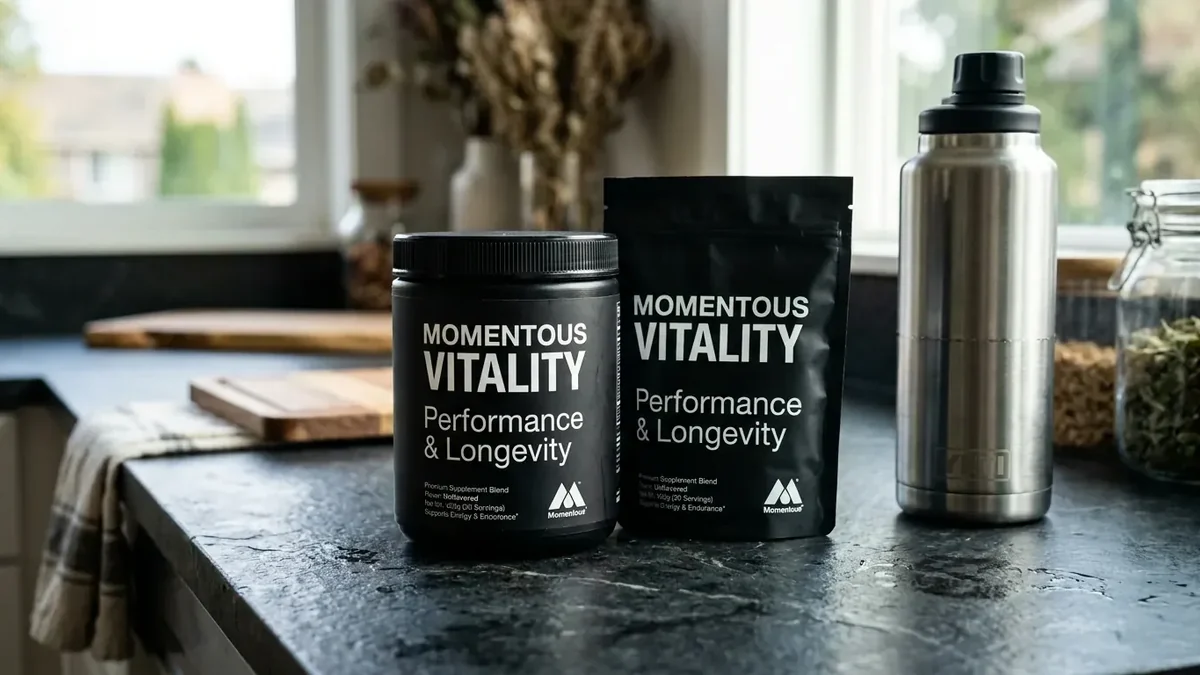
Creatine is a compound your muscles use for quick energy during hard efforts, and creatine monohydrate is its most studied form (Kreider et al., 2017). Beginners do well with a simple protocol: 3 to 5 grams of creatine monohydrate daily with a meal. This guide covers who it suits, three essentials to know, and a first-30-days plan.
Not medical advice — ask your clinician: This article is for informational and educational purposes only and is not medical advice. Consult your physician or pharmacist before starting creatine, especially if you have pre-existing kidney disease, are pregnant or breastfeeding, are under 18, or take medications affecting renal function or fluid balance:
- Given my kidney health history and current medication list, is a 3 to 5 gram daily dose of plain creatine monohydrate appropriate for me?
- Should I note my creatine supplementation before upcoming metabolic or serum creatinine lab panels so an expected creatinine rise is not misread?
- Which independent third-party verification program (NSF Certified for Sport, USP Verified, or Informed Sport) matches my health or athletic needs?
- 01 Is Creatine for You? (A 60-Second Self-Check)
- 02 The Only 3 Things a Beginner Must Know
- 2.1 What Creatine Actually Does (Cellular Energy, Not a Stimulant)
- 2.2 Why Creatine Monohydrate Is the Only Form You Need
- 2.3 Consistency Beats Timing (3 to 5 Grams Every Day)
- 03 Your First 30 Days: The Starter Protocol
- 04 Do You Need to Load? (The Beginner’s Answer)
- 05 Women Over 40: Read This First
- 06 Beginner Myths, Answered
- 6.1 Myth 1: "Creatine Is an Anabolic Steroid"
- 6.2 Myth 2: "Creatine Causes Fat Gain or Permanent Bloating"
- 6.3 Myth 3: "Creatine Causes Hair Loss"
- 6.4 Myth 4: "Creatine Damages Healthy Kidneys"
- 6.5 Myth 5: "You Have to Cycle Off Creatine Every 8 Weeks"
- 07 What to Buy (and What to Skip)
- 08 When to Expect What: Weeks 1 to 4
- 09 Safety Basics and the Clinician Conversation
- 10 Your Next Step
- 11 60-Second Label Audit (Expanded)
- 12 Frequently Asked Questions
- 12.1 Should a beginner start with 3 grams or 5 grams of creatine per day?
- 12.2 What happens if I miss a day of creatine?
- 12.3 Should I take creatine on rest days when I do not work out?
- 12.4 Can I take creatine at night without ruining my sleep?
- 12.5 Why did the scale go up 1 to 2 pounds in my first two weeks?
- 12.6 Does taking creatine with coffee cancel out its benefits?
- 12.7 Is powder or capsules better for a beginner?
- 12.8 Do I need to work out for creatine to work?
- Keep the formula simple: Choose 100% pure, unflavored micronized creatine monohydrate with a verified third-party seal (NSF Certified for Sport or Informed Sport) and zero fillers.
- Start with 3 to 5 grams once daily: Skip the 20 g/day loading week—a single daily 3 to 5 g scoop reaches 100% muscle saturation in 21 to 28 days (Hultman et al., 1996) with better stomach comfort.
- Habit beats timing: Creatine works by gradually filling muscle energy stores over weeks, not via an acute 30-minute buzz. Take it at whatever meal you will never forget.
- Expect a 1 to 3 lb water shift: Creatine pulls water inside muscle fibers—this is healthy intracellular hydration, not body fat.
- Check with your clinician first if needed: Anyone with kidney disease, reduced eGFR, pregnancy, or diuretic/nephrotoxic medications should consult a physician first.
Is Creatine for You? (A 60-Second Self-Check)
Supplement labels often make a simple nutrient sound like an extreme bodybuilding drug. In reality, creatine is a natural amino-acid compound synthesized daily by your liver and kidneys and found in beef, poultry, and fish. As explained in our complete creatine guide, supplemental creatine simply tops off skeletal muscle energy reserves from their typical 60%–80% baseline up to 100% capacity.
Who benefits most from starting creatine:
- Adults starting or maintaining resistance training: Lifting weights or doing resistance sessions 2 to 3 times weekly pairs with creatine to support extra reps and steady strength progression.
- Interval and recreational athletes: Runners, cyclists, and court-sport players performing short sprints rely directly on the phosphocreatine energy system.
- Adults over 40 focused on healthy aging: Preserving skeletal muscle mass and functional strength is critical after 40 as age-related muscle loss (sarcopenia) accelerates.
- Vegetarians and vegans: Plant-based eaters consume almost zero dietary creatine, start with 20%–30% lower muscle stores, and respond strongly to supplementation (Burke et al., 2003).
Who should speak with a physician first: Anyone with pre-existing kidney disease (reduced eGFR), individuals taking nephrotoxic medications or prescription diuretics, pregnant or breastfeeding women, and adolescents under 18 must consult a clinician before starting.
The Only 3 Things a Beginner Must Know
Before opening your first container, anchor on three foundational facts from human exercise physiology:
1. What Creatine Actually Does (Cellular Energy, Not a Stimulant)
During a heavy lift or sprint, muscle cells burn adenosine triphosphate (ATP), which lasts only 2 to 3 seconds. Stored phosphocreatine (PCr) acts as an immediate intracellular battery, donating a phosphate group to regenerate fresh ATP within milliseconds. Because creatine contains zero caffeine or stimulants, it never causes jitters or a racing heart.
2. Why Creatine Monohydrate Is the Only Form You Need
More than 95% of human safety and performance trials—over 1,000 studies reviewed by the International Society of Sports Nutrition (Kreider et al., 2017)—used creatine monohydrate. Pricier alternatives like creatine HCl, buffered creatine, liquid creatine, and ethyl ester have never outperformed monohydrate in human muscle-biopsy trials.
3. Consistency Beats Timing (3 to 5 Grams Every Day)
Because creatine works by gradually saturating muscle tissue over three to four weeks rather than triggering an acute workout spike, taking 3 to 5 grams every single day (including rest days) matters far more than whether you take it before or after the gym.
Your First 30 Days: The Starter Protocol
Follow this five-step protocol across your first 30 days to reach full muscle saturation comfortably:
%3C/text%3E%3Crect x='312' y='45' width='136' height='108' rx='6' fill='%23ffffff' stroke='%230284c7' stroke-width='2'/%3E%3Ctext x='380' y='72' text-anchor='middle' font-family='sans-serif' font-size='12' font-weight='bold' fill='%23075985'%3E3. Mix Completely%3C/text%3E%3Ctext x='380' y='95' text-anchor='middle' font-family='sans-serif' font-size='11' fill='%23475569'%3E8 to 12 oz Water,%3C/text%3E%3Ctext x='380' y='113' text-anchor='middle' font-family='sans-serif' font-size='11' fill='%23475569'%3EShake, or Yogurt%3C/text%3E%3Crect x='459' y='45' width='136' height='108' rx='6' fill='%23ffffff' stroke='%230284c7' stroke-width='2'/%3E%3Ctext x='527' y='72' text-anchor='middle' font-family='sans-serif' font-size='12' font-weight='bold' fill='%23075985'%3E4. Anchor Habit%3C/text%3E%3Ctext x='527' y='95' text-anchor='middle' font-family='sans-serif' font-size='11' fill='%23475569'%3ETake Daily With%3C/text%3E%3Ctext x='527' y='113' text-anchor='middle' font-family='sans-serif' font-size='11' fill='%23475569'%3EBreakfast / Meal%3C/text%3E%3Crect x='606' y='45' width='136' height='108' rx='6' fill='%23ecfdf5' stroke='%23047857' stroke-width='2'/%3E%3Ctext x='674' y='72' text-anchor='middle' font-family='sans-serif' font-size='12' font-weight='bold' fill='%23065f46'%3E5. Lift + Hydrate%3C/text%3E%3Ctext x='674' y='95' text-anchor='middle' font-family='sans-serif' font-size='11' fill='%231e293b'%3E2-3x Weekly Lift%3C/text%3E%3Ctext x='674' y='113' text-anchor='middle' font-family='sans-serif' font-size='11' fill='%231e293b'%3E100%25 by Day 28%3C/text%3E%3C/svg%3E)
- Step 1 — Verify Your Supplement Label: Confirm the Supplement Facts panel lists Creatine Monohydrate as the sole ingredient (Other Ingredients: None) and carries a recognized third-party mark.
- Step 2 — Measure One Level 3 to 5 Gram Scoop: Smaller beginners (under 140 lb) or those with sensitive digestion can start at 3 grams daily; most adults use a standard 5-gram scoop.
- Step 3 — Dissolve in 8 to 12 Ounces of Liquid or Food: Stir into 8 to 12 oz of water, a protein shake, smoothie, or yogurt. Fine 200-mesh micronized powder suspends smoothly without grit.
- Step 4 — Anchor to an Existing Daily Habit: Keep the container beside your coffee maker or dinner plates so you take it at the same meal every day—both training days and rest days.
- Step 5 — Pair With 2 to 3 Weekly Resistance Workouts and Hydration: Drink an extra glass of water with your scoop and strength train 2 to 3 days per week.
Do You Need to Load? (The Beginner’s Answer)
Many tub labels recommend a "loading phase" of 20 grams per day (four 5 g doses) for 5 to 7 days. For 95% of beginners, loading is unnecessary.
Human muscle-biopsy research by Hultman et al. (1996) proved that a steady 3 to 5 grams once daily reaches the exact same ~140–160 mmol/kg dry-muscle saturation ceiling at Day 28 as a 20 g/day loading week reaches at Day 7. Skipping loading saves 105 grams of powder, avoids four-times-daily scheduling, and reduces osmotic stomach cramping (Ostojic & Ahmetovic, 2008). Read our guide on whether a loading phase is necessary for the 28-day cost math.
Women Over 40: Read This First
Women in their 40s and 50s often hesitate over two concerns: fear of looking "bulky" and confusion over Week 1 scale weight. First, creatine has zero calories and zero hormones; in controlled trials of perimenopausal and postmenopausal women, pairing 3 to 5 g/day of monohydrate with resistance training supports lean muscle tone, functional strength, and lower-body bone mineral density preservation (Chilibeck et al., 2017; Smith-Ryan et al., 2021). Second, women typically see a gentle intracellular water shift (0.5 to 1.5 lb) inside muscle cells when starting at 3 to 5 g/day without loading. Skip overpriced pastel "women’s creatine" blends and read our complete guide to creatine for women over 40.
Beginner Myths, Answered
Myth 1: "Creatine Is an Anabolic Steroid"
Fact: Creatine has zero hormonal or structural similarity to steroids. It is a natural tripeptide (arginine, glycine, methionine) found in meat and fish and is 100% legal under NCAA, Olympic, and WADA rules.
Myth 2: "Creatine Causes Fat Gain or Permanent Bloating"
Fact: Pure creatine monohydrate contains zero calories. When creatine enters muscle fibers, it osmotically draws water inside the muscle cell—any 1 to 3 lb scale change is intracellular muscle water, not fat.
Myth 3: "Creatine Causes Hair Loss"
Fact: This rumor stems from a single 2009 study of 20 rugby players (van der Merwe et al., 2009) that noted a normal-range shift in serum DHT. That study never measured hair loss, and no trial in 15+ years has replicated it (Antonio et al., 2021).
Myth 4: "Creatine Damages Healthy Kidneys"
Fact: Controlled trials in healthy adults show no adverse effect of 3 to 5 g/day creatine on kidney filtration (Kreider et al., 2017). Because creatine degrades into serum creatinine—a lab marker used to estimate eGFR—tell your physician you take creatine before blood draws and ask about a Cystatin C test.
Myth 5: "You Have to Cycle Off Creatine Every 8 Weeks"
Fact: Daily 3 to 5 g maintenance dosing does not permanently suppress natural creatine synthesis after stopping; continuous daily use is standard in clinical studies.
| Common Beginner Myth | Clinical Reality | Practical Takeaway |
|---|---|---|
| "It is a steroid or stimulant" | Amino-acid energy buffer (ATP/PCr); zero hormones or caffeine | Safe morning or evening without jitters |
| "It makes you gain body fat" | Zero calories; pulls 1 to 3 lb of water inside muscle cells | Expect a slight scale bump from hydrated muscle |
| "It causes baldness" | 2009 DHT study never measured hair and was never replicated | No clinical evidence links creatine to hair loss |
| "It harms healthy kidneys" | Raises benign serum creatinine marker without harming filtration | Disclose use before labs; request Cystatin C |
| "You must load and cycle off" | Steady 3–5 g/day saturates muscles in 28 days; no cycling needed | Take one 3–5 g scoop daily year-round |
What to Buy (and What to Skip)
Apply this four-check beginner label test before buying your first tub:
- Check 1 — Single Active Ingredient: Must list Creatine Monohydrate delivering 3 to 5 g per scoop. Skip proprietary blends, liquid creatine, and ethyl ester.
- Check 2 — "Other Ingredients: None": Unflavored micronized powder needs zero sugars, dyes, or fillers.
- Check 3 — Independent Third-Party Seal: Look for NSF Certified for Sport, USP Verified, Informed Sport, or Informed Choice, and learn how to verify supplement seals in 90 seconds.
- Check 4 — Fair Cost per 5 g Serving ($0.20 to $0.50): Avoid $1.00+ per serving gummies or markups. See how to choose a verified creatine monohydrate for our full price comparison.
%3C/text%3E%3Crect x='386' y='45' width='170' height='104' rx='8' fill='%23ecfeff' stroke='%230284c7' stroke-width='2'/%3E%3Ctext x='471' y='72' text-anchor='middle' font-family='sans-serif' font-size='12' font-weight='bold' fill='%23075985'%3E3. Verified Seal%3C/text%3E%3Ctext x='471' y='96' text-anchor='middle' font-family='sans-serif' font-size='11' fill='%231e293b'%3ENSF Sport, Informed,%3C/text%3E%3Ctext x='471' y='114' text-anchor='middle' font-family='sans-serif' font-size='11' fill='%231e293b'%3Eor ISO 17025 COA%3C/text%3E%3Crect x='569' y='45' width='170' height='104' rx='8' fill='%23fffbeb' stroke='%23d97706' stroke-width='2'/%3E%3Ctext x='654' y='72' text-anchor='middle' font-family='sans-serif' font-size='12' font-weight='bold' fill='%2392400e'%3E4. Fair Price%3C/text%3E%3Ctext x='654' y='96' text-anchor='middle' font-family='sans-serif' font-size='11' fill='%231e293b'%3E$0.20 to $0.50%3C/text%3E%3Ctext x='654' y='114' text-anchor='middle' font-family='sans-serif' font-size='11' fill='%231e293b'%3Eper 5g Serving%3C/text%3E%3C/svg%3E)
When to Expect What: Weeks 1 to 4
- Week 1 (Days 1 to 7) — Building the Routine: Muscle phosphocreatine rises ~25%–35% toward ceiling. Scale weight may shift +0.5 to 1.5 lb as muscle fibers draw in water; no stimulant buzz occurs.
- Week 2 (Days 8 to 14) — Halfway Saturated: Stores reach ~50%–65% capacity; final reps on working sets begin feeling steadier.
- Week 3 (Days 15 to 21) — Approaching Full Capacity: Stores reach ~80%–90%; recovery between 60-to-90-second lifting rest periods improves.
- Week 4 (Days 22 to 28) — 100% Tissue Saturation: Full muscle phosphocreatine saturation is achieved (Hultman et al., 1996), supporting progressive strength gains across subsequent months.
%3C/text%3E%3Ctext x='105' y='95' text-anchor='middle' font-family='sans-serif' font-size='16' font-weight='bold' fill='%230284c7'%3E~30%25 Full%3C/text%3E%3Ctext x='105' y='118' text-anchor='middle' font-family='sans-serif' font-size='11' fill='%23475569'%3EHabit formation;%3C/text%3E%3Ctext x='105' y='136' text-anchor='middle' font-family='sans-serif' font-size='11' fill='%23475569'%3E+0.5-1.5 lb cell water%3C/text%3E%3Crect x='203' y='45' width='170' height='118' rx='8' fill='%23ffffff' stroke='%230284c7' stroke-width='2'/%3E%3Ctext x='288' y='70' text-anchor='middle' font-family='sans-serif' font-size='12' font-weight='bold' fill='%23075985'%3EWeek 2 (Days 8-14)%3C/text%3E%3Ctext x='288' y='95' text-anchor='middle' font-family='sans-serif' font-size='16' font-weight='bold' fill='%230284c7'%3E~60%25 Full%3C/text%3E%3Ctext x='288' y='118' text-anchor='middle' font-family='sans-serif' font-size='11' fill='%23475569'%3ESteadier final reps%3C/text%3E%3Ctext x='288' y='136' text-anchor='middle' font-family='sans-serif' font-size='11' fill='%23475569'%3Eon working sets%3C/text%3E%3Crect x='386' y='45' width='170' height='118' rx='8' fill='%23ffffff' stroke='%23047857' stroke-width='2'/%3E%3Ctext x='471' y='70' text-anchor='middle' font-family='sans-serif' font-size='12' font-weight='bold' fill='%23065f46'%3EWeek 3 (Days 15-21)%3C/text%3E%3Ctext x='471' y='95' text-anchor='middle' font-family='sans-serif' font-size='16' font-weight='bold' fill='%23047857'%3E~85%25 Full%3C/text%3E%3Ctext x='471' y='118' text-anchor='middle' font-family='sans-serif' font-size='11' fill='%23475569'%3EImproved recovery%3C/text%3E%3Ctext x='471' y='136' text-anchor='middle' font-family='sans-serif' font-size='11' fill='%23475569'%3Ebetween lifting sets%3C/text%3E%3Crect x='569' y='45' width='170' height='118' rx='8' fill='%23ecfdf5' stroke='%23047857' stroke-width='2'/%3E%3Ctext x='654' y='70' text-anchor='middle' font-family='sans-serif' font-size='12' font-weight='bold' fill='%23065f46'%3EWeek 4 (Day 28)%3C/text%3E%3Ctext x='654' y='95' text-anchor='middle' font-family='sans-serif' font-size='16' font-weight='bold' fill='%23047857'%3E100%25 Saturated%3C/text%3E%3Ctext x='654' y='118' text-anchor='middle' font-family='sans-serif' font-size='11' fill='%231e293b'%3EFull PCr ceiling%3C/text%3E%3Ctext x='654' y='136' text-anchor='middle' font-family='sans-serif' font-size='11' fill='%231e293b'%3E(Hultman et al., 1996)%3C/text%3E%3C/svg%3E)
Safety Basics and the Clinician Conversation
- Keep Single Doses at or Below 5 Grams: Single doses of 10 g+ on an empty stomach can draw water into the intestine and cause loose stools (Ostojic & Ahmetovic, 2008). Take a single 3 to 5 g scoop with food and water.
- Tell Your Doctor Before Routine Blood Panels: Supplemental creatine mildly elevates benign serum creatinine on standard metabolic panels (CMP); inform your doctor and ask whether a Cystatin C blood check is appropriate.
- Respect Medical Contraindications: Do not start creatine without physician clearance if you have chronic kidney disease, reduced eGFR, proteinuria, pregnancy, or take nephrotoxic/diuretic drugs.
Your Next Step
Select a verified single-ingredient micronized creatine monohydrate using our guide to choosing the best creatine monohydrate, take 3 to 5 grams with a daily meal, and pair it with two to three weekly resistance-training sessions.
60-Second Label Audit (Expanded)
- Single-ingredient check: confirm the Supplement Facts panel lists creatine monohydrate as the only active ingredient. First-time buyers do not need multi-stage "performance matrices," liquid creatine, or buffered salts. Plain micronized creatine monohydrate is the exact compound validated across decades of human exercise and muscle-energetics research.
- Serving math: check the grams per scoop (3–5 g) and total servings per tub before buying. Most single-ingredient tubs provide a 5-gram scoop and between 60 and 100 servings per container, lasting two to three months at one scoop daily. Confirming both numbers on the Supplement Facts panel prevents under-dosing or running out early.
- Third-party seals: verify an NSF, USP, or Informed Sport certification mark on the tub or official product page. Independent third-party testing confirms that the white powder inside the tub is 100 percent creatine monohydrate free from heavy-metal or banned-substance cross-contamination. Always verify the seal in the certifier's public online database rather than relying on generic marketing badges.
- Other ingredients: avoid unnecessary sweeteners, food dyes, and proprietary blends. Unflavored micronized creatine monohydrate lists "None" under Other Ingredients, meaning every gram you scoop is active creatine. Flavored pre-workout blends often add sucralose, artificial colors, and caffeine that you neither need nor want for daily maintenance.
- Price per serving: divide the bottle price by the number of servings to compare true daily cost. Because the creatine monohydrate molecule is chemically identical across reputable brands, comparing price per 5-gram serving is the fairest way to judge value. Most third-party certified tubs fall between $0.40 and $1.15 per daily serving.
Frequently Asked Questions
1. Should a beginner start with 3 grams or 5 grams of creatine per day?
Both doses reach 100% muscle saturation in 3 to 4 weeks. Smaller adults (under 140 lb) or beginners with sensitive stomachs often start at 3 grams daily, while average-sized adults take one standard 5-gram scoop daily.
2. What happens if I miss a day of creatine?
Nothing dramatic happens. Saturated muscle stores wash out slowly (~1% to 2% per day over 4 to 6 weeks). Simply resume your normal 3 to 5 g scoop the next day without double-dosing.
3. Should I take creatine on rest days when I do not work out?
Yes. Taking your 3 to 5 g dose on rest days keeps intramuscular phosphocreatine stores at 100% capacity for your next workout.
4. Can I take creatine at night without ruining my sleep?
Yes. Pure creatine monohydrate contains zero caffeine or stimulants, so evening dosing will not disrupt sleep.
5. Why did the scale go up 1 to 2 pounds in my first two weeks?
Creatine pulls water inside skeletal muscle fibers as tissue stores fill up. That 1 to 2 lb shift is healthy intracellular muscle water, not fat.
6. Does taking creatine with coffee cancel out its benefits?
No. Normal daily coffee or tea intake does not block muscle creatine saturation.
7. Is powder or capsules better for a beginner?
Both contain the same molecule, but micronized powder is far cheaper and requires just one small scoop, whereas capsules require swallowing 4 to 7 pills for 5 grams.
8. Do I need to work out for creatine to work?
For muscle strength and lean mass gains, yes—creatine works by supporting higher training quality during resistance exercise, so pair it with 2 to 3 weekly lifting sessions.
Related Articles
- The Complete Creatine Guide: Benefits, Dosage, Safety & How to Buy
- Best Creatine Monohydrate: How to Choose & 60-Second Label Checklist
- Creatine Loading Phase: Is It Necessary? Protocol, Cost & Research
- Creatine for Women Over 40: Evidence-Graded Benefits & Dosing
- NSF vs USP vs Informed Sport: Supplement Seals Explained
- Head-to-Head Comparison of Two NSF Certified for Sport Creatine Powders
- Kreider, R. B., et al. (2017). ISSN position stand: creatine supplementation. JISSN, 14, 18.
- Hultman, E., et al. (1996). Muscle creatine loading in men. J Appl Physiol, 81(1), 232–237.
- Antonio, J., et al. (2021). Common questions and misconceptions about creatine supplementation. JISSN, 18, 13.
- Burke, D. G., et al. (2003). Creatine and weight training in vegetarians. Med Sci Sports Exerc, 35(11), 1946–1955.
- Ostojic, S. M., & Ahmetovic, Z. (2008). GI distress after creatine supplementation. Res Sports Med, 16(1), 15–22.
- Chilibeck, P. D., et al. (2017). Creatine during resistance training in older adults. Open Access J Sports Med, 8, 213–226.
- Smith-Ryan, A. E., et al. (2021). Creatine supplementation in women’s health. Nutrients, 13(3), 877.
- October 16, 2026: Published brand-neutral beginner guide with 60-second self-check, 5-step first-30-days starter protocol, 5 beginner myths table, 4-check label test, Weeks 1–4 timeline, and 8 FAQs.