A standard thyroid blood panel starts with TSH (thyroid-stimulating hormone) and free T4 to evaluate primary thyroid function, adding free T3 and thyroid antibodies (TPOAb and TgAb) when symptoms or family history suggest autoimmune Hashimoto's or Graves' disease. Always test before starting biotin or iodine-containing supplements, which can distort lab results.
- 01 TSH: The Pituitary Signal
- 02 Free T4 and Free T3
- 03 Thyroid Antibodies: TPOAb and TgAb
- 04 How to Prepare for a Thyroid Blood Test
- 05 What Your Results Can't Tell You
- 06 Supplements Don't Replace Testing
- 07 Take This to Your Appointment: The Expanded Lab & Label Checklist
- 08 Frequently Asked Questions
- 8.1 What is a TSH test?
- 8.2 What is the difference between free T4 and free T3?
- 8.3 What do thyroid antibodies (TPOAb) indicate?
- 8.4 Do I need to fast before a thyroid blood test?
- 8.5 Should I take my thyroid medication before the test?
- 8.6 Can supplements affect thyroid blood test results?
- 8.7 Can a thyroid supplement replace thyroid testing?
Whether you are preparing for a routine checkup or exploring thyroid basics for women's wellness, understanding the names on a laboratory requisition makes your appointment far more productive. Below is a plain-language guide to the four core markers on a thyroid blood panel, how to prepare before your draw, and what lab numbers alone cannot tell you.
1. TSH: The Pituitary Signal
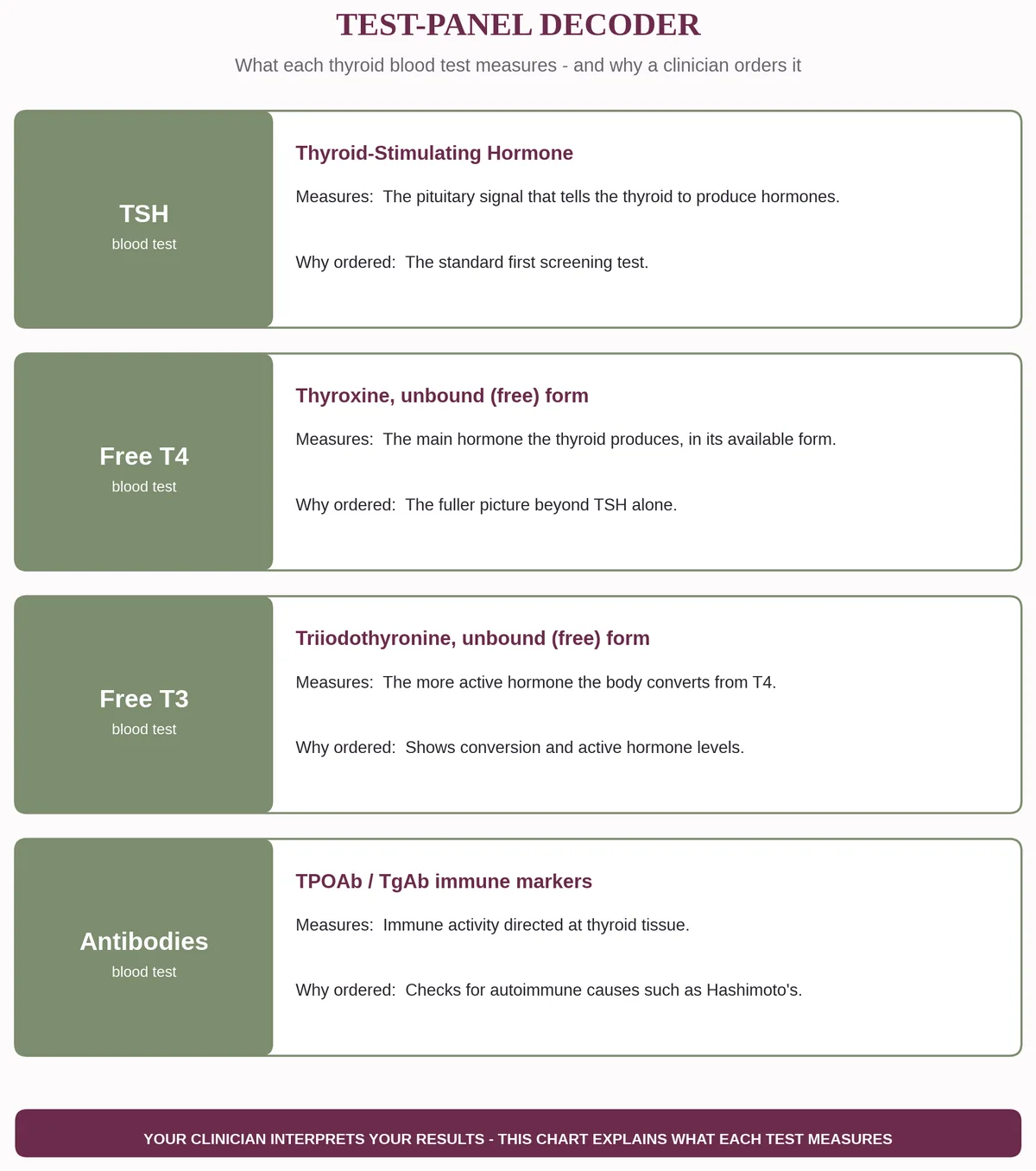
What does a TSH test measure? TSH stands for thyroid-stimulating hormone (also called thyrotropin), a chemical messenger produced not by the thyroid itself, but by the pea-sized pituitary gland at the base of the brain (American Thyroid Association). In healthy physiology, the pituitary and the thyroid communicate through a continuous negative-feedback loop: when circulating thyroid hormone levels dip, the pituitary releases more TSH to prompt the thyroid to step up production; when circulating thyroid hormone levels rise, the pituitary dials TSH secretion down (Endocrine Society).
Because the pituitary responds exponentially to even subtle shifts in circulating free thyroxine, medical societies including the American Thyroid Association (ATA), the Endocrine Society, and the UK National Health Service (NHS) recognize TSH as the most sensitive first-line screening marker for primary thyroid function. In educational literature from those organizations, a directional pattern works like an inverse thermostat:
- What a high TSH pattern generally suggests (attributed): According to the American Thyroid Association and the Endocrine Society, an elevated TSH indicates that the pituitary gland is asking the thyroid for more hormone output — a pattern commonly discussed in connection with an underactive thyroid (hypothyroidism).
- What a low TSH pattern generally suggests (attributed): Conversely, clinical guidance from the ATA and NHS explains that a suppressed or low TSH indicates the pituitary is easing off its signal — a pattern commonly discussed in connection with an overactive thyroid (hyperthyroidism), excessive exogenous thyroid hormone intake, or less commonly, central pituitary conditions.
Crucially, TSH alone is a pituitary signal rather than a complete diagnosis. Many women first ask for a TSH check when navigating overlapping midlife complaints — see our companion guide on thyroid symptoms during perimenopause for why symptom checklists cannot separate the two. Furthermore, laboratory reference ranges vary by lab, assay manufacturer, patient age, pregnancy trimester, and time of day, so no universal cutoff applies to every person. Reference ranges vary by lab and should be interpreted by your clinician. Only your clinician can interpret your results in context.
2. Free T4 and Free T3
While TSH reflects what the brain is requesting, Free T4 and Free T3 measure the actual hormones circulating in your bloodstream. Over ninety-nine percent of the hormone secreted by the thyroid gland travels bound to carrier proteins in the blood (such as thyroxine-binding globulin, or TBG), where it remains biologically inactive like money held in reserve (American Thyroid Association). The word "Free" on a lab order refers to the tiny unbound fraction that is free to enter body tissues and bind to cellular receptors.
- Free T4 (Free Thyroxine): Thyroxine (T4) is the principal hormone produced and released by the thyroid gland. Because total T4 levels can be skewed upward or downward by estrogen therapy, oral contraceptives, pregnancy, or liver protein shifts without any true change in thyroid function, clinicians routinely pair Free T4 with TSH as the core two-marker diagnostic panel (Endocrine Society).
- Free T3 (Free Triiodothyronine): Triiodothyronine (T3) is the more metabolically active thyroid hormone at the cellular level. Most circulating T3 is not secreted directly by the thyroid; instead, peripheral tissues convert T4 into T3 using deiodinase enzymes. According to the ATA and NHS, Free T3 is ordered less routinely for initial hypothyroid screening (because the body often preserves normal T3 levels until underactivity is advanced), but clinicians frequently add Free T3 when evaluating suspected hyperthyroidism or complex pituitary-thyroid patterns.
In clinical textbooks from the Endocrine Society, the American Thyroid Association, and the NHS, the combination of TSH and Free T4/T3 is described solely in terms of what the paired markers measure: a high TSH paired with a low Free T4 is the classic laboratory pattern discussed with overt primary hypothyroidism; a high TSH paired with a normal Free T4 is discussed as a subclinical pattern that clinicians often monitor or re-check over time; and a low TSH paired with an elevated Free T4 or Free T3 is the pattern discussed with hyperthyroidism. These combinations describe how laboratory assays work — never a self-diagnosis chart. Only your clinician can interpret your results in context.
3. Thyroid Antibodies: TPOAb and TgAb
Unlike TSH, Free T4, and Free T3 — which measure hormones — a thyroid antibody panel measures immune system proteins (autoantibodies) directed against components of the thyroid gland itself (National Institute of Diabetes and Digestive and Kidney Diseases, NIDDK). When the immune system mistakenly flags thyroid proteins as foreign, lymphocytes produce specific antibodies that can be detected in a venous blood sample:
- TPOAb (Thyroid Peroxidase Antibodies): Targets thyroid peroxidase, the key enzyme inside thyroid follicles responsible for oxidizing iodine and attaching it to thyroglobulin. According to the American Thyroid Association and NIDDK, elevated TPO antibodies are the hallmark immune marker most commonly associated with Hashimoto's thyroiditis, the leading cause of hypothyroidism in iodine-sufficient regions such as the United States.
- TgAb (Thyroglobulin Antibodies): Targets thyroglobulin, the large storage protein inside the thyroid gland from which T4 and T3 are cleaved. Clinicians sometimes order TgAb alongside TPOAb when autoimmune thyroiditis is suspected or when monitoring specific thyroid conditions (Endocrine Society).
An essential clinical distinction emphasized by endocrinologists is that antibodies indicate immune activity, not a hormone level. A person can have positive thyroid antibodies for years while maintaining completely normal TSH and Free T4 output, and a clinician decides whether antibody testing or periodic TSH follow-up is warranted based on your history and exam. Only your clinician can interpret your results in context. For readers who came here for blood-test definitions and are also curious about how thyroid-support nutrients fit into a wellness routine, our main review audits how commercial supplement labels differ from medical care.
| Test | What it measures | Why it's ordered | One thing to know |
|---|---|---|---|
| TSH | Pituitary hormone signaling the thyroid to make hormones. | Standard first-line screening marker for overall thyroid function. | Moves inversely to thyroid output; ranges vary by lab. |
| Free T4 | Unbound, usable fraction of thyroxine made by the thyroid. | Paired with TSH to confirm how much hormone circulates. | Avoids protein-binding distortions from estrogen or pregnancy. |
| Free T3 | Unbound fraction of the active hormone converted from T4. | Added mainly when evaluating suspected overactive thyroid patterns. | Ordered less routinely in initial underactive thyroid screening. |
| Antibodies (TPOAb / TgAb) | Immune proteins targeting thyroid peroxidase or thyroglobulin. | Ordered when autoimmune involvement like Hashimoto's is suspected. | Signals immune activity, not current thyroid hormone output. |
4. How to Prepare for a Thyroid Blood Test
How you prepare for a thyroid blood draw can influence laboratory assay readouts and how easily your clinician can compare results from one visit to the next. Before your appointment, review four practical preparation factors with the clinic or laboratory ordering your panel:
- Fasting instructions depend on your full order: Many laboratories do not require fasting for an isolated TSH and Free T4 draw, but primary-care clinicians frequently bundle thyroid tests onto the same requisition as a fasting lipid panel or fasting blood glucose test. Always follow your specific lab's instructions rather than general advice online.
- Time of day and the daily TSH rhythm: Secretion of TSH follows a circadian rhythm in humans, peaking overnight and reaching lower levels in the mid-afternoon (Endocrine Society). Booking a morning blood draw — and keeping follow-up draws at roughly the same time of day — helps your clinician compare consistent snapshots against morning reference populations.
- Prescription thyroid medication timing: If you already take prescribed thyroid hormone replacement (such as levothyroxine or liothyronine), the timing of your morning tablet relative to the venipuncture needle can temporarily elevate serum Free T4 for several hours after ingestion. Ask your ordering clinician in advance whether they want you to take your morning dose before the blood draw or hold it until immediately after the draw — never change your routine without asking them.
- High-dose biotin and supplement interference: According to safety communications from the American Thyroid Association and the FDA, high-dose biotin (vitamin B7, frequently found in hair, skin, and nail supplements) can interfere with streptavidin-biotin laboratory immunoassays, causing falsely low TSH or falsely high Free T4/T3 readouts on the lab machine even when your actual thyroid hormones are normal. Tell your clinician and the phlebotomist about every supplement you take, and see our separate evidence breakdown on what the research says about iodine and selenium.
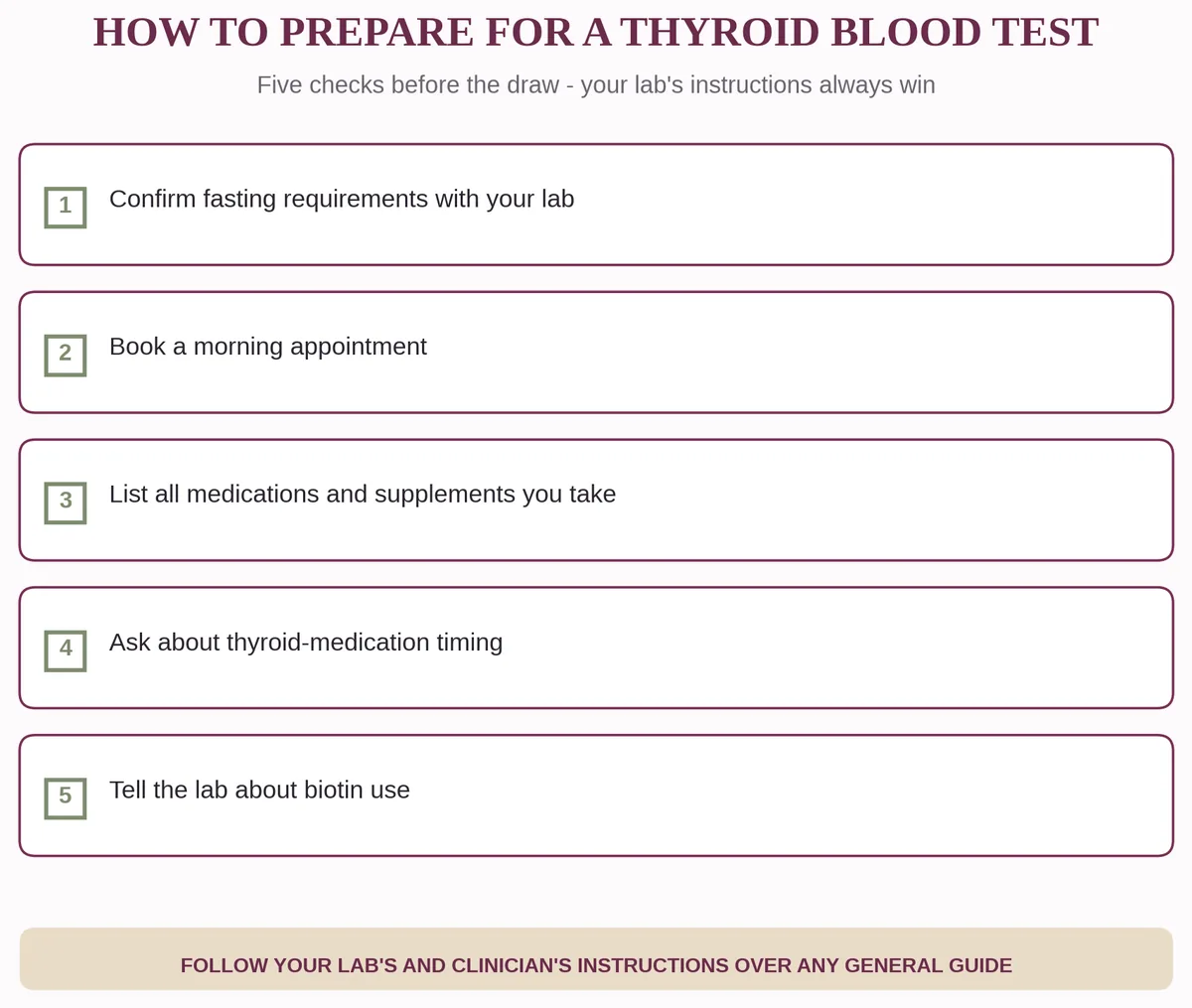
Pre-Appointment Checklist: How to Prepare for a Thyroid Blood Test
- Confirm fasting requirements with your lab (especially if lipids or glucose are ordered on the same draw).
- Book a morning appointment so your clinician can compare results at a consistent point in TSH's daily rhythm.
- Bring a complete list of all medications and dietary supplements to share with your ordering clinician.
- Ask your prescriber about thyroid medication timing (whether to take your morning tablet before or after the blood draw).
- Tell both your clinician and the lab if you take biotin (including hair/skin/nail gummies or B-complex formulas).
5. What Your Results Can't Tell You
Even a comprehensive laboratory printout has inherent boundaries that every patient benefits from understanding before opening their patient portal:
- A single blood draw is a single-day snapshot: Thyroid hormone signaling is dynamic. Acute viral illness, hospital recovery, severe caloric restriction, sleep deprivation, and seasonal or reproductive transitions can transiently nudge TSH up or down without representing permanent gland failure (American Thyroid Association). That is why a single normal TSH does not automatically rule out every clinical question, and why clinicians frequently repeat a borderline or unexpected value weeks later before making long-term decisions.
- Tests measure markers — they do not explain symptoms in isolation: A lab machine reports hormone and antibody concentrations in plasma; it cannot see your menstrual history, iron stores (ferritin), vitamin D or B12 status, sleep apnea, stress load, or physical neck exam. Identifying why you feel fatigued requires a clinician correlating laboratory markers with your complete medical history and physical examination.
- Reference ranges are population statistics, not personal targets: When a laboratory prints a "reference interval" beside your result, that span simply represents the central ninety-five percent of values measured in a broad reference group tested on that specific instrument. Because reference ranges vary by lab, assay methodology, age bracket, and pregnancy status, a value near the edge of a population curve means different things for different patients — which is why portal flags never replace a conversation with your doctor.
6. Supplements Don't Replace Testing
Important Clinical & YMYL Notice: No over-the-counter dietary supplement — ThyraFemme Balance included — replaces a thyroid blood test, diagnoses any thyroid condition, or substitutes for professional clinician guidance. Taking kelp, iodine, or herbal blends before getting evaluated can even complicate laboratory interpretation or aggravate underlying thyroid disorders.
Anyone experiencing persistent symptoms or reviewing abnormal lab results should work directly with a qualified physician or endocrinologist, and never start, stop, or adjust prescribed thyroid medication (such as levothyroxine, Synthroid, liothyronine, or Armour Thyroid) on their own. Only your clinician can interpret your results in context. This article is not medical advice.
Common questions about thyroid blood tests, answered.
Related Thyroid Supplement Audits: Read our Is ThyraFemme a Scam? 2026 Trust & Label Audit for a full breakdown of the name-only label disclosure, 60-day guarantee, and unauthorized marketplace listings, or see ThyraFemme Balance vs Thyroid Support Complex alongside our ThyraFemme Balance Review.
Take This to Your Appointment: The Expanded Lab & Label Checklist
- Clarify the goal: separate symptom tracking and clinical blood testing from over-the-counter supplement marketing. Blood markers such as TSH, Free T4, Free T3, and thyroid antibodies answer specific diagnostic questions that no dietary supplement can resolve. Use your appointment to pair your blood-test requisition and symptom history with your clinician's interpretation rather than relying on supplement marketing claims.
- Check full disclosure: look for transparent per-ingredient listing and independent third-party testing seals. If you are already taking a wellness or hair-and-skin supplement prior to lab work, inspect the Supplement Facts panel for hidden biotin, kelp, or trace minerals that could affect your results. Independent third-party testing seals also help verify that a product does not contain undeclared compounds that might cloud your clinical picture.
- Review timing rules: ask your clinician or pharmacist how supplements, biotin, or minerals interact with lab draws or prescriptions. Lab preparation rules—such as drawing blood at a consistent morning hour, knowing whether to hold your morning thyroid tablet until after the draw, and pausing biotin beforehand—directly affect how your results read on paper. Confirm these exact timing instructions with the ordering clinician or laboratory before your appointment day.
- Bring your full list: share every capsule, powder, and medication at your appointment. Because laboratory reference intervals must be interpreted alongside your medications, life stage, pregnancy status, and supplement intake, your doctor needs a complete inventory of what you take. Bringing a written list or smartphone photos of every bottle label helps your provider interpret your thyroid panel accurately.
Frequently Asked Questions
What is a TSH test?
TSH (thyroid-stimulating hormone) is made by the pituitary gland and signals the thyroid to produce hormones. Clinicians commonly order it as the first screening test when thyroid function is being checked.
What is the difference between free T4 and free T3?
Free T4 is the main hormone the thyroid produces; free T3 is the more active form the body converts from T4. "Free" means the unbound portion available for use. Clinicians order them to see the fuller picture beyond TSH.
What do thyroid antibodies (TPOAb) indicate?
TPO antibodies are immune markers associated with autoimmune thyroid activity, most commonly Hashimoto's thyroiditis. They indicate immune activity, not a hormone level, and a clinician decides whether antibody testing is warranted.
Do I need to fast before a thyroid blood test?
It depends on the panel: TSH alone often does not require fasting, but broader panels frequently do. Follow your lab's or clinician's instructions rather than general guidance online.
Should I take my thyroid medication before the test?
Ask your clinician. Timing of thyroid medication relative to the blood draw can affect results, so this is a question for the person ordering your test — not something to decide from an article.
Can supplements affect thyroid blood test results?
Yes — high-dose biotin is known to interfere with some thyroid assays, and clinicians generally want a full list of what you take. Tell your clinician about every supplement, and see our women's thyroid support guide for how nutrients fit into a wellness routine.
Can a thyroid supplement replace thyroid testing?
No. No supplement replaces testing, diagnoses a thyroid condition, or substitutes for clinician guidance. Anyone with symptoms or abnormal results should work with a clinician. This article is not medical advice.